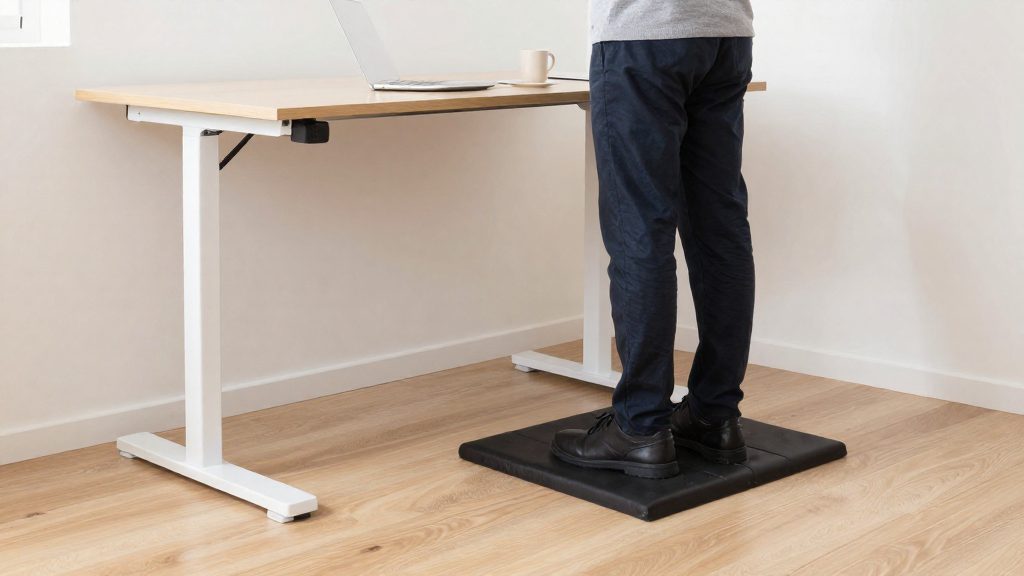
The official CCOHS sources consulted do not show that an anti-fatigue mat helps on its own. At most it is one part of the answer, alongside frequent position changes, supportive footwear and a suitable floor surface. The Canadian Centre for Occupational Health and Safety (CCOHS) states that standing is not dangerous in itself. Prolonged, regular standing can cause sore feet, leg swelling, varicose veins, muscle fatigue, low back pain, and stiffness in the neck and shoulders. Cleanlink (2013), reporting on CCOHS guidance, links mats with frequent position changes, supportive footwear, and a softer floor. The CCOHS page itself does not make this recommendation.
Is an anti-fatigue mat useful with a standing desk?
A mat changes the surface you stand on, not how long you stand. CCOHS (2022-11-30) advises against standing on bare concrete or metal, and prefers wood, cork, or rubber. If you use a mat, choose one with beveled edges to limit trip hazards. CCOHS also advises against thick rubber foam mats, which can increase fatigue and the risk of falling.
| Floor surface | CCOHS guidance (2022-11-30) |
|---|---|
| Bare concrete or metal | Avoid |
| Wood, cork, or rubber | Preferred |
| Mat with beveled edges | Recommended if a mat is used |
| Thick rubber foam mat | Discouraged: may increase fatigue and fall risk |
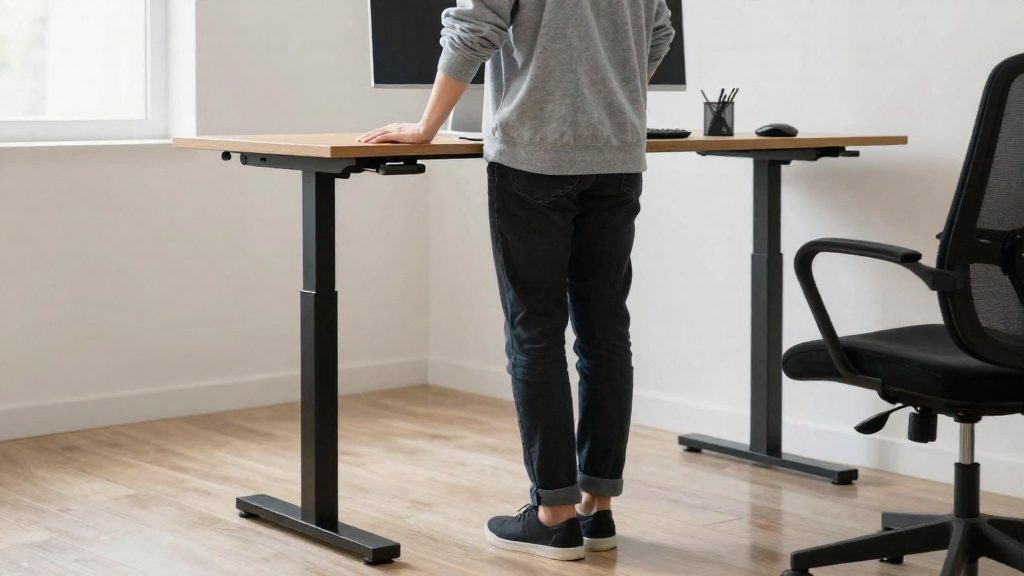
Position changes matter as much as the mat. CCOHS recommends changing position often, keeping each position brief, taking breaks, and walking. It also suggests a footrest or support bar so you can shift weight from one leg to the other. According to CCOHS (2022-11-30), alternating frequently between sitting and standing helps prevent fatigue, and the desk should be adjustable so you can choose your position.
Footwear and floor cushioning are the third factor. CCOHS recommends shoes with good heel support, arch support, lace closure, and enough room for the toes, plus cushioned soles on hard floors.
As reported by Cleanlink (2013-04-19), CCOHS considers prolonged standing “particularly stressful and tiring” and recommends anti-fatigue mats combined with position changes, supportive shoes, and a softer floor. The official sources consulted do not confirm this wording on the CCOHS page itself, so treat it as a secondary report.
What the CCOHS says about prolonged standing
According to the Canadian Centre for Occupational Health and Safety (CCOHS, 2022), standing is not dangerous in itself. Prolonged and regular standing can, however, cause sore feet, leg swelling, varicose veins, muscle fatigue, low back pain, and stiffness in the neck and shoulders. CCOHS therefore recommends changing position often and keeping each position for a short time.
Recommended working habits
- Change position often, and keep each position for a short time.
- Take regular breaks and walk.
- Use a footrest or a foot bar to shift weight from one leg to the other.
- Alternate between sitting and standing frequently, and set the desk height for each user so that position changes are easy to make.
Floor surface and mats
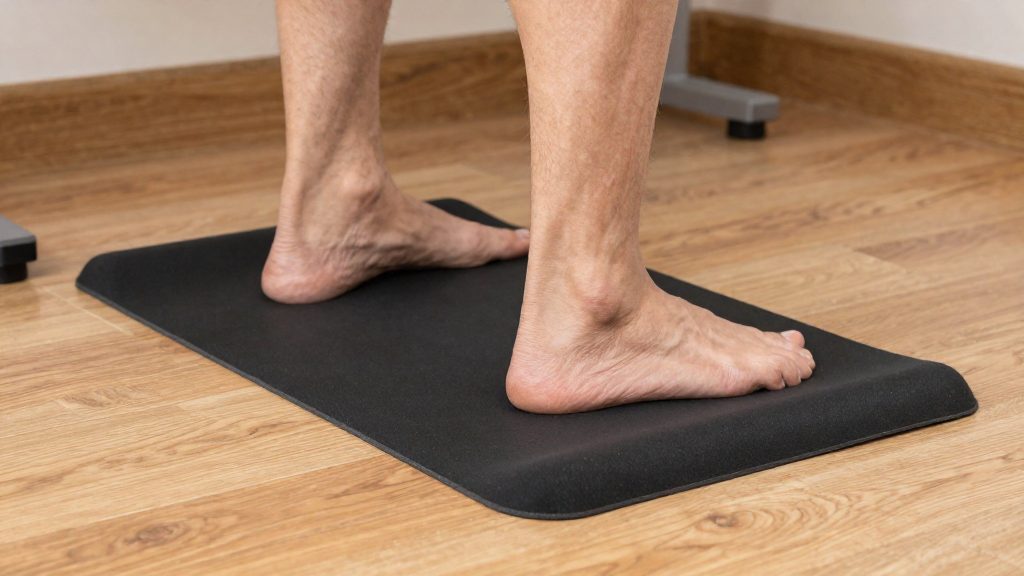
CCOHS advises against standing on bare concrete or metal. It prefers wood, cork, or rubber surfaces. If you use a mat, CCOHS recommends beveled edges to reduce the risk of tripping, and it advises against thick foam rubber mats, which can increase fatigue and the risk of falls.
Footwear
CCOHS recommends shoes with good heel support, arch support, lace closure, and enough room for the toes. On hard floors, it recommends cushioned soles.
Anti-fatigue mats in context
Cleanlink (2013) reports that CCOHS-linked guidance describes prolonged standing as “particularly stressful and tiring” and recommends anti-fatigue mats combined with position changes, supportive shoes, and a softer floor. This wording is attributed to Cleanlink; it does not appear on the CCOHS page itself, so treat it as a secondary source. The official sources consulted do not specify a recommended mat thickness or density.
How to choose an anti-fatigue mat: thickness, edges and material
The CCOHS (2022-11-30) states that standing is not dangerous in itself, but prolonged and repeated standing can cause sore feet, leg swelling, varicose veins, muscle fatigue, low back pain, and neck and shoulder stiffness. A mat addresses only part of that risk, so choose it for the surface it provides and for how it fits your workstation.
Surface material
The CCOHS advises against standing on bare concrete or bare metal. It prefers the following materials underfoot:
| Surface | CCOHS guidance |
|---|---|
| Wood | Preferred |
| Cork | Preferred |
| Rubber | Preferred, but not thick foam rubber (see below) |
| Bare concrete | Advised against |
| Bare metal | Advised against |
Thickness
The official sources consulted do not specify a recommended thickness. The CCOHS does warn against thick rubber foam mats, which can increase fatigue and the risk of falling. When you compare products, check the thickness and the material together, and keep in mind that CCOHS advises against thick rubber foam mats.
Edges
The CCOHS recommends beveled edges to limit the risk of tripping. Before buying, check that the edges slope gently to the floor. Before first use, confirm that the mat lies flat and does not curl at the corners.
Mat as part of a broader setup
Cleanlink (2013-04-19) reports that the CCOHS recommends anti-fatigue mats combined with position changes, supportive footwear and a softer floor. The CCOHS also advises changing position often, keeping each position for a short time, and using a footrest or footbar to shift weight from one leg to the other.
Why Alternating Between Sitting and Standing Remains Essential
According to CCOHS (2022), standing is not dangerous in itself. Prolonged and regular standing, however, can cause sore feet, swollen legs, varicose veins, muscle fatigue, low back pain, and stiffness in the neck and shoulders. An anti-fatigue mat reduces some of this strain, but it works best when combined with frequent position changes. The CCOHS recommends changing position often, keeping each position short, taking breaks, and walking.
The main CCOHS recommendations for people who alternate between sitting and standing at a standing desk are:
| Factor | CCOHS recommendation (2022) |
|---|---|
| Position changes | Change position often and hold each position for a short time |
| Breaks and movement | Take breaks and walk |
| Weight shifting | Use a footrest or a foot bar to move weight from one leg to the other |
| Desk height | Adjust to the user and allow a choice between sitting and standing |
| Seated knee angle | Keep the knees bent at about 90° with a footrest |
CCOHS states that alternating frequently between sitting and standing helps prevent fatigue. Switching between the two positions, combined with weight shifting, limits the duration of any single static posture.
Cleanlink (2013) reported that the CCOHS considers prolonged standing “particularly stressful and tiring.” According to that same report, the CCOHS recommends anti-fatigue mats together with position changes, supportive footwear, and a softer floor. The CCOHS also warns that thick rubber foam mats can increase fatigue and the risk of falling, so the mat’s thickness and material matter as much as its presence.
Which shoes and floor surface to choose?
Shoes and floor surface change how much standing load reaches your feet, legs and back, and both can be checked before you buy or install anything. The CCOHS (2022) gives specific criteria for each, which work as a purchase and setup checklist.
Checking a pair of shoes
According to CCOHS (2022), standing-work shoes should have:
| Feature | What to check |
|---|---|
| Heel support | The heel stays firmly in place when you stand and shift weight |
| Arch support | The arch is supported, so the foot does not collapse inward |
| Lace closure | Laces allow you to adjust fit across the foot during the day |
| Toe room | Enough space so the toes can move without pressing against the front |
| Cushioned sole | Recommended on hard floors to absorb impact |
Check heel hold and toe room when you try shoes on.
Matching the floor surface
CCOHS (2022) advises against standing on bare concrete or bare metal. It prefers wood, cork or rubber. If you use a mat, the same guidance applies to its construction:
| Surface | CCOHS guidance (2022) |
|---|---|
| Bare concrete or bare metal | Advised against |
| Wood, cork or rubber | Preferred |
| Thick foam rubber mat | Advised against, as it can increase fatigue and the risk of falling |
| Mat with beveled edges | Recommended, to limit the risk of tripping |
Cleanlink (2013) reported that anti-fatigue mats are recommended alongside position changes, supportive shoes and a softer floor, rather than as a standalone solution. That report is Cleanlink’s summary; it is not a statement from the CCOHS page itself.
How to set up your home-office standing workstation?
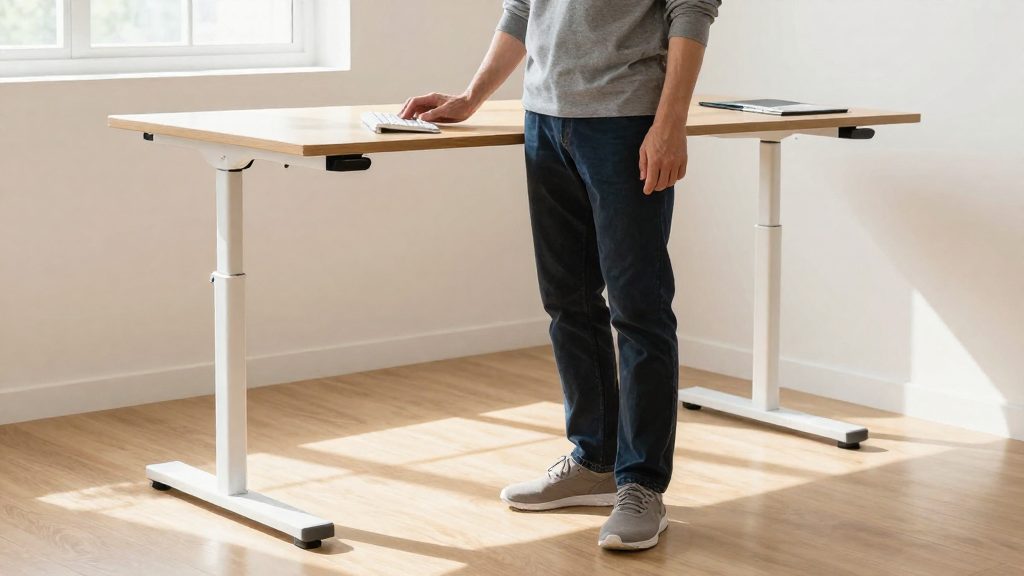
A standing workstation depends less on one piece of equipment than on how you move between positions. According to CCOHS (2022), alternating frequently between sitting and standing helps prevent fatigue, and the workstation should be height-adjustable so each user can choose their position. Standing is not hazardous in itself, but prolonged, repeated standing can cause sore feet, leg swelling, varicose veins, muscle fatigue, low back pain, and stiffness in the neck and shoulders (CCOHS, 2022).
Your setup should cover four elements:
- Position changes: change posture often, hold each position for a short time, and take breaks to walk.
- Desk height: adjust the height to you, and set a footrest so that your knees stay bent at about 90° when you sit.
- Floor surface: choose a surface that cushions your feet, as described in the table below.
- Footwear: wear shoes with the features listed below.
Choosing a floor surface
| Floor surface | CCOHS guidance (2022) |
|---|---|
| Bare concrete or metal | Avoid |
| Wood, cork, or rubber | Preferred |
| Thick foam rubber mat | Avoid: can increase fatigue and the risk of falling |
| Mat with bevelled edges | Recommended to limit the risk of tripping |
Choosing footwear
CCOHS recommends shoes with:
- Good heel support
- Arch support
- A lace-up closure
- Enough room for your toes
- Cushioned soles on hard floors
Cleanlink (2013) reports that CCOHS considers prolonged standing “particularly stressful and tiring,” and recommends anti-fatigue mats combined with position changes, supportive shoes, and a softer floor. This wording comes from Cleanlink’s article rather than from the CCOHS page itself.
Position changes, weight shifting and footwear to limit standing strain
Standing is not dangerous in itself, but prolonged and repeated standing can cause sore feet, leg swelling, varicose veins, muscle fatigue, low back pain, and stiffness in the neck and shoulders, according to CCOHS (2022-11-30). The moves below apply the CCOHS recommendations for reducing that strain. They complement an anti-fatigue mat and do not replace it.
Change position regularly
Position changes are the core gesture. CCOHS recommends:
- Changing position often
- Holding each position for a short time
- Taking breaks and walking during the day
- Alternating frequently between sitting and standing to avoid fatigue (CCOHS, 2022-11-30)
Shift weight from one leg to the other
Weight shifting reduces the load on one leg during standing work. CCOHS suggests using a footrest or a support bar so you can rest one leg, then switch to the other. The footrest or bar gives you a fixed point to lean on without changing your posture.
Set the seated position correctly
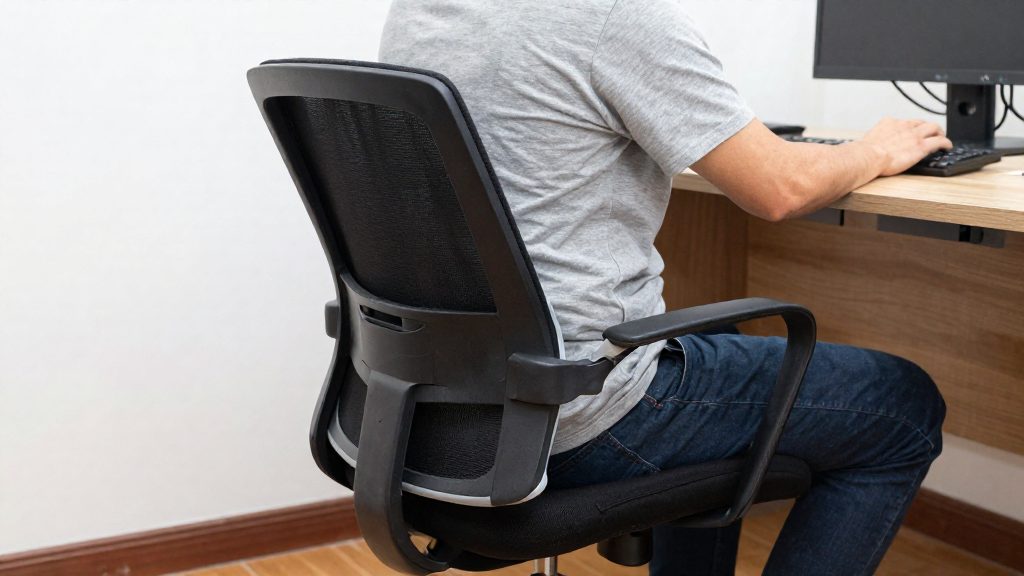
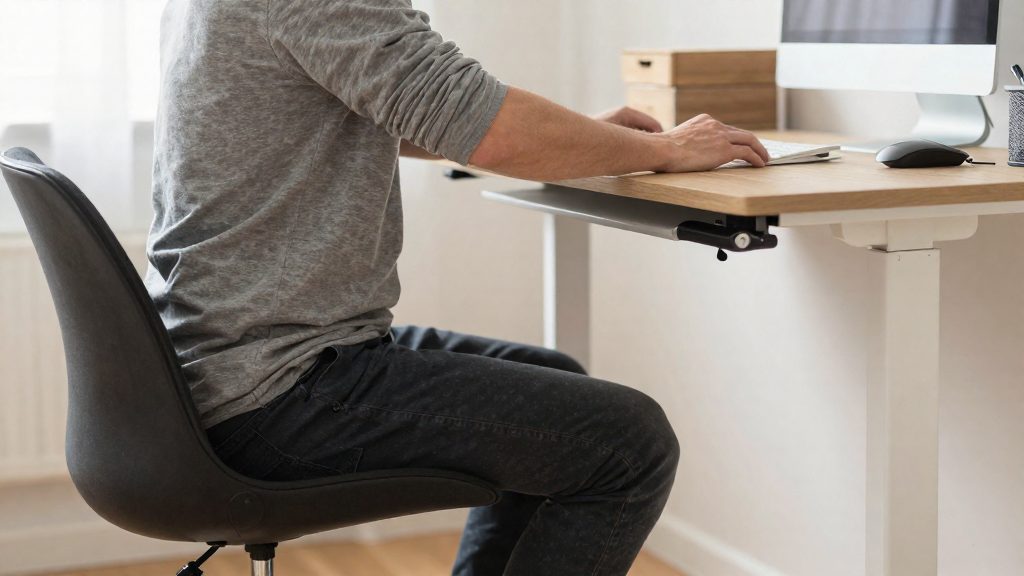
When you sit, CCOHS states that the workstation should be adjustable in height for each user and should let you choose between sitting and standing. A footrest should keep your knees bent at about 90°. This angle matters because it is the position you return to between standing periods.
Choose supportive footwear
CCOHS recommends shoes with good heel support, arch support, lace closure, and enough room for the toes. On hard floors, CCOHS recommends cushioned soles.
Frequently asked questions
Is an anti-fatigue mat enough on its own at a standing desk?
The official CCOHS sources consulted do not show that a mat helps by itself. It works best alongside position changes, supportive footwear and a suitable floor, and CCOHS (2022-11-30) prefers wood, cork or rubber underfoot over bare concrete or metal.
How thick should an anti-fatigue mat be?
The official sources consulted do not specify a thickness or density. CCOHS (2022-11-30) only advises against thick rubber foam mats, which can increase fatigue and the risk of falling, and recommends beveled edges if you use a mat.
Do you need special shoes or insoles for standing at a desk?
CCOHS (2022-11-30) recommends shoes with good heel support, arch support, lace closure and enough room for the toes. For hard floors, its guidance points to cushioned soles rather than insoles.