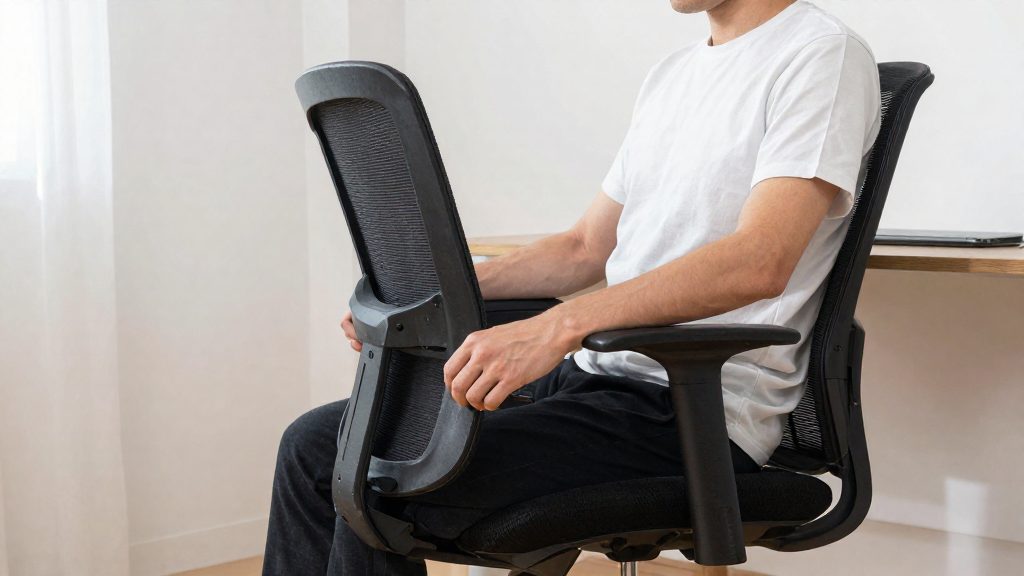
Tall users need a chair with a wider adjustment range because a standard model is sized for an average body. When seat depth, seat height, or backrest travel falls short, the result is pressure behind the knees, unsupported thighs, or feet that cannot rest flat. According to CCOHS (2026), a fully adjustable chair typically fits about 95% of the population, and the roughly 5% at the extremes of body size may need alternative chairs. This guide covers the CCOHS settings to check when a chair must fit a tall body: seat height, seat depth, backrest, armrests and base. The sources consulted give no tall-specific dimensions, so the test is whether the chair’s adjustment range reaches the settings your body requires.
Why do tall users need a suitable chair?
Seat depth is the first constraint. CCOHS (2026) states that seat depth should suit both the tallest and the shortest users, with the back against the backrest and no pressure behind the knees. A seat that is too deep presses behind the knees of a shorter user, while a seat that is too shallow leaves a taller user’s thighs unsupported. If several people share one chair, the depth should suit both the tallest and the shortest users.
Seat height is set so the highest point of the horizontal seat sits just below the kneecap, with feet flat on the floor. CCOHS (2026) gives a rule of thumb that optimal seat height is about one-quarter of body height, but notes that torso-to-leg ratios vary, so this is only an estimate. Use the figure as a starting point, then adjust it by feel.
| Adjustment | Setting (CCOHS, 2026) |
|---|---|
| Seat front edge | A clenched fist (about 5 cm / 2 in) fits between the edge and the calves; the edge curves toward the floor |
| Armrests | Just touch the undersides of the elbows, with elbows bent at about 90° |
| Armrest removal | Remove them if the lowest setting still raises the elbows |
| Backrest | Adjusts vertically and front to back to fit the hollow of the lower back |
Armrests that extend 25 cm (10 in) or less from the back of the seat may be appropriate, according to CCOHS (2026). Check that this length does not block the chair from reaching the desk.
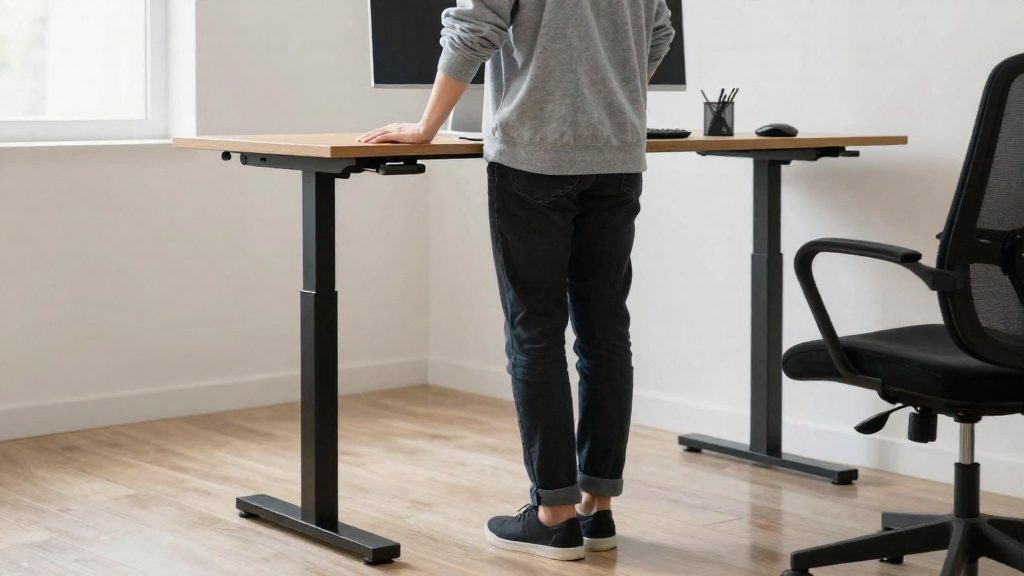
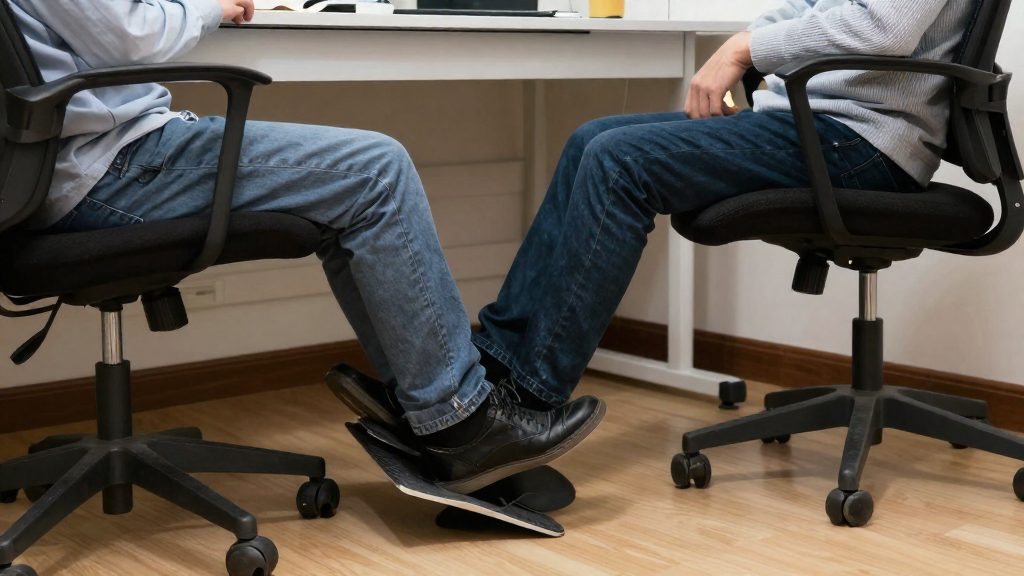
With a fixed-height desk, lower the chair until the elbows are level with the work surface. If the feet then do not rest flat on the floor, add a footrest. If the feet then do not rest flat at that height, a footrest solves the problem.

Seat Height: Setting It Correctly
Set the seat so that the highest point of the horizontal seat sits just below your kneecap, with both feet flat on the floor. According to CCOHS (2026), this is the reference point for seat height. It applies to tall users as well, because the seat is adjusted to the leg length rather than to overall body size.
Step 1: Find the starting height. Sit with your back against the backrest and your feet flat. Raise or lower the seat until its top edge sits just below the kneecap. CCOHS (2026) also gives a rule of thumb: optimal seat height is about one-quarter of body height. Torso-to-leg ratios vary, so treat this figure as an estimate. For a user who is 190 cm tall, it gives roughly 47.5 cm, which is only a point to compare against the kneecap method.
Step 2: Check the front edge. A clenched fist (about 5 cm / 2 in) should fit between the front edge of the seat and your calves. The front edge should curve toward the floor and should not press on the thighs or the back of the knees. If it still presses after the height is set, the chair does not fit your leg length well.
Step 3: Match the desk. On a fixed-height desk, lower the chair until your elbows are level with the work surface. If your feet cannot rest flat on the floor at that height, add a footrest.
| Check | Target |
|---|---|
| Seat top vs. kneecap | Just below the kneecap |
| Feet | Flat on the floor, or on a footrest |
| Clearance at front edge | About 5 cm (2 in) for a clenched fist |
| Elbows on a fixed desk | Level with the work surface |
| Rule of thumb | About one-quarter of body height (estimate) |
CCOHS (2026) notes that a fully adjustable chair typically fits about 95% of the population, and that the remaining 5% at the extremes of body size may need alternative chairs. If a chair cannot reach the kneecap height with your feet flat, test it in your actual work setting before purchase.
Seat depth and clearance behind the knees
For tall users, the main test of seat depth is whether you can sit with your back fully against the backrest while the front edge of the seat stays clear of the back of your knees. According to CCOHS (2026), seat depth should suit both the tallest and the shortest users, with no pressure behind the knees. The official sources consulted do not specify a seat depth in centimetres, so the check is functional: the seat must fit your body, not match a dimension on a spec sheet.
How to check the gap
- Sit with your back against the backrest and your feet flat on the floor.
- Slide a clenched fist between the front edge of the seat and your calves. CCOHS (2026) gives this clearance as about 5 cm (2 in).
- Check that the seat does not press on your thighs or the back of your knees.
- If the fist does not fit, or the seat presses behind your knees, the depth does not suit you and the chair needs adjustment or replacement.
Seat front shape
CCOHS (2026) states that the front edge should curve toward the floor. A curved edge helps keep the seat from pressing on the thighs or the back of the knees. Check the shape at the same time as the depth, because a seat with the right depth can still press on the thighs if its front edge is squared off.
| Criterion | Target (CCOHS, 2026) |
|---|---|
| Clearance between seat front and calves | A clenched fist (about 5 cm / 2 in) fits |
| Seat front edge | Curves toward the floor; does not press on thighs or back of knees |
| Pressure behind knees | None when the back is against the backrest |
| Feet | Flat on the floor, or on a footrest if they do not reach |
Testing in your workspace
CCOHS (2026) advises employees to trial a chair in their real work setting. Test the depth over a full working session, not only for a few minutes. CCOHS (2026) also notes that roughly 5% of people at the extremes of body size may need alternative chairs, so if no adjustment achieves the fist clearance, consider a chair with a different seat depth range.
Backrest and lumbar support for a long torso
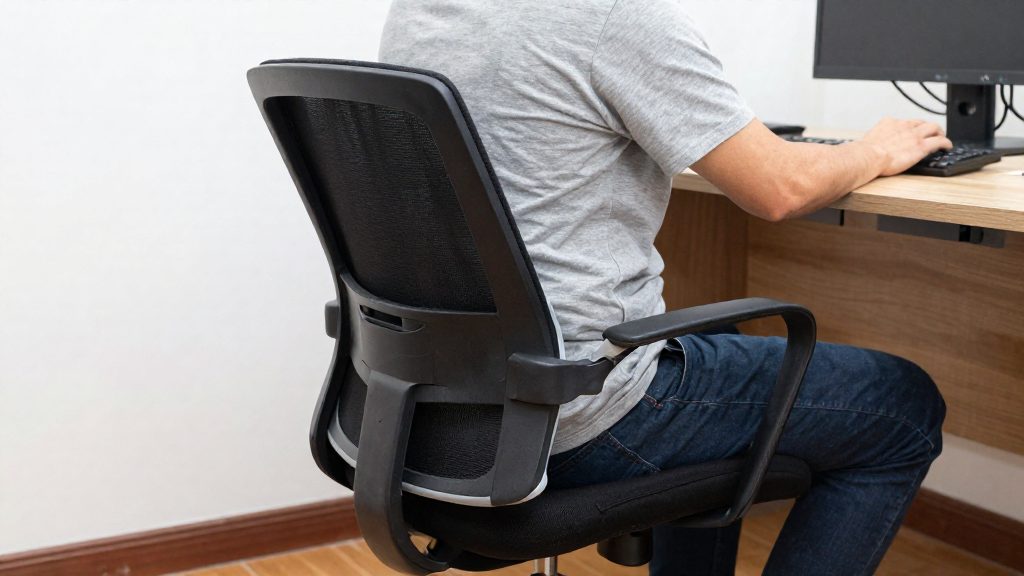
For tall users, backrest fit depends on torso length as well as overall height. CCOHS (2026) notes that torso-to-leg ratios vary between people, so a chair sized only by height may not match your spine. The backrest should adjust both vertically and front to back, so that its support sits in the hollow of your lower back.
To check the fit:
- Sit with your back against the backrest and your feet flat on the floor.
- Raise or lower the backrest until its contact point sits in the hollow of your lower back.
- Move the backrest forward or back until that hollow is filled without pushing you forward off the seat.
- Confirm that the seat edge does not press on the back of your knees.
The seat depth should work for both the tallest and the shortest users, with your back against the backrest and no pressure behind the knees (CCOHS, 2026). When comparing models, check the stated seat depth range rather than relying on the chair’s overall size.
Stability also depends on the base. CCOHS (2026) recommends a five-point base for stability.
CCOHS (2026) states that a fully adjustable chair typically fits about 95% of the population. The remaining roughly 5% at the extremes of body size may need alternative chairs, so a tall user should expect that some standard models will not fit.
| Feature | What to check | Source |
|---|---|---|
| Backrest height | Adjusts vertically to fit the hollow of the lower back | CCOHS (2026) |
| Backrest depth | Adjusts front to back | CCOHS (2026) |
| Base | Five-point base for stability | CCOHS (2026) |
| Seat depth | Suits tallest and shortest users; no pressure behind knees | CCOHS (2026) |
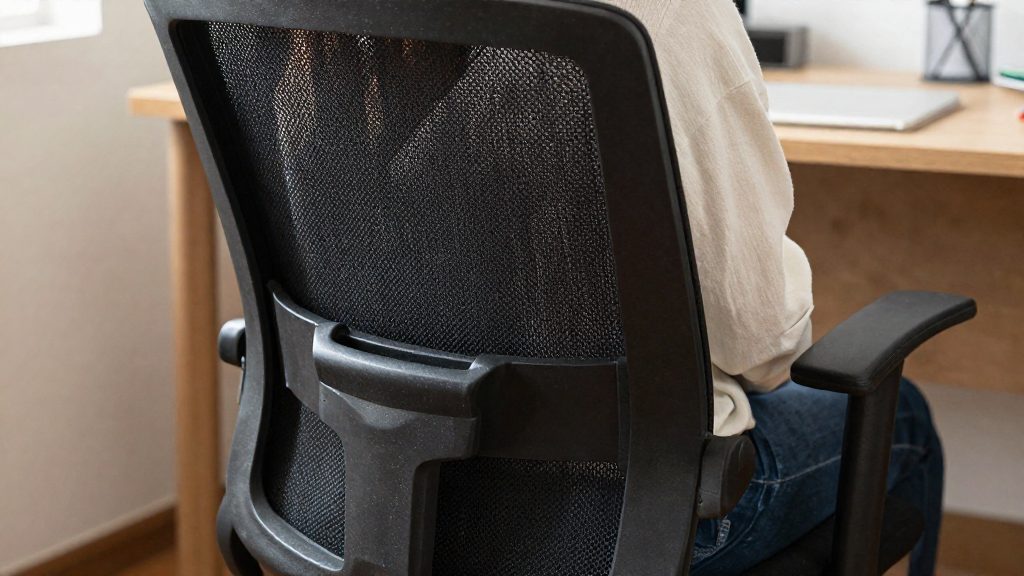
Armrests: when to remove them
Armrests are set by the elbow, not by the armrest itself. According to CCOHS (2026), the armrests should just touch the undersides of the elbows, with the elbows bent at about 90°. If that position cannot be reached, the armrests should be removed.
Adjustment method
- Sit with your back against the backrest and your shoulders relaxed.
- Raise or lower each armrest until its pad just touches the underside of the elbow.
- Check that the elbow is bent at about 90°.
- Lower the armrest to its lowest setting and check the elbow again.
Removal rule
If the armrests at their lowest setting still raise the elbows, remove them. Armrests that hold the arm above the desk cannot be lowered further to fix this, so removal is the only option the guidance gives.
Armrest length
Armrests extending 25 cm (10 in) or less from the back of the seat may be appropriate (CCOHS, 2026). Measure from the back of the seat to the front edge of the pad. The official sources consulted do not specify a recommendation for longer armrests.
| Check | Guidance |
|---|---|
| Armrest contact | Just touching the undersides of the elbows |
| Elbow angle | About 90° |
| Lowest setting | If elbows still rise, remove the armrests |
| Length from seat back | 25 cm (10 in) or less may be appropriate |
With a fixed-height desk, lower the chair so the elbows sit level with the work surface. If the feet then do not rest flat on the floor, add a footrest (CCOHS, 2026).
Is one adjustable chair enough for everyone?
A fully adjustable chair typically fits about 95% of the population, according to CCOHS (2026). The remaining roughly 5% at the extremes of body size may need alternative chairs. For taller users, the practical question is whether the chair’s adjustment range covers the seat height, seat depth and backrest position their body requires, not whether the chair is adjustable in general.
Seat depth is one of the settings to check carefully. CCOHS (2026) advises that seat depth should suit both the tallest and the shortest users, with the back against the backrest and no pressure behind the knees. Check it by sitting fully back: if the front edge presses on the back of your knees, the seat is too deep. A clenched fist (about 5 cm / 2 in) should fit between the front edge and your calves.
| Setting | Target (CCOHS, 2026) | If it does not fit |
|---|---|---|
| Seat height | Highest point of the seat just below the kneecap, feet flat on the floor | Use a footrest if the feet do not rest flat |
| Armrests | Just touching the undersides of the elbows, elbows bent at about 90° | Remove them if they still raise the elbows at their lowest setting |
| Backrest | Adjusts vertically and front to back to fit the hollow of the lower back | Choose a chair with a wider adjustment range |
| Base | Five-point base recommended for stability | No stated alternative in the source |
With a fixed-height desk, CCOHS (2026) recommends lowering the chair until the elbows are level with the work surface. If the desk is too low for the chair to reach that position, the chair alone cannot correct the mismatch.
A chair also does not reduce sitting time. CCOHS (2026) advises against sitting uninterrupted for more than one hour, and suggests about 5 minutes of moderate-to-vigorous activity for every 40–50 minutes of sitting.
Breaks and movement to complement the chair
A well-adjusted chair reduces strain on the body, but it does not remove the need to move. CCOHS (2026) advises avoiding uninterrupted sitting for more than one hour and suggests about 5 minutes of moderate-to-vigorous activity for every 40–50 minutes of sitting. These figures set a practical rhythm: a short active break should happen before the one-hour mark, not only at the end of a long session.
| Element | Guidance (CCOHS, 2026) |
|---|---|
| Maximum uninterrupted sitting | Avoid sitting for more than one hour |
| Suggested activity | About 5 minutes of moderate-to-vigorous activity per 40–50 minutes of sitting |
Interrupting sitting is part of the guidance alongside chair adjustment. Build breaks into your routine rather than relying on memory:
- Stand up to take phone calls or read documents.
- Walk to a printer, a kitchen, or another part of the building if your workplace allows it.
- Set a recurring reminder at intervals shorter than one hour.
Moderate-to-vigorous activity means movement that raises your breathing rate, such as brisk walking. Light shifting in the chair does not meet this threshold, so a break should include standing and walking, not only a change of position.
The official sources consulted do not specify how these intervals should be adapted for people with specific medical conditions. If you have a condition that affects mobility or circulation, check the recommended break pattern with a qualified health professional.
Frequently asked questions
How can I tell if a chair’s seat is too shallow or too deep for my legs?
Check the gap behind your knees and whether your thighs are supported up to the knee. According to CCOHS (2026), the seat depth should suit the user with the back against the backrest and no pressure behind the knees.
What should I do if my desk is fixed-height and my feet don’t reach the floor?
Lower the chair until your elbows are level with the work surface, then place a footrest under your feet if they still do not rest flat. CCOHS (2026) gives this as the approach for fixed-height desks.
Is a standard office chair enough for a tall user, or do I need a specialised model?
Start with a fully adjustable chair and test it in your actual work setting before buying. CCOHS (2026) estimates that such chairs fit about 95% of people, and the remaining users at the extremes of body size may need an alternative chair.