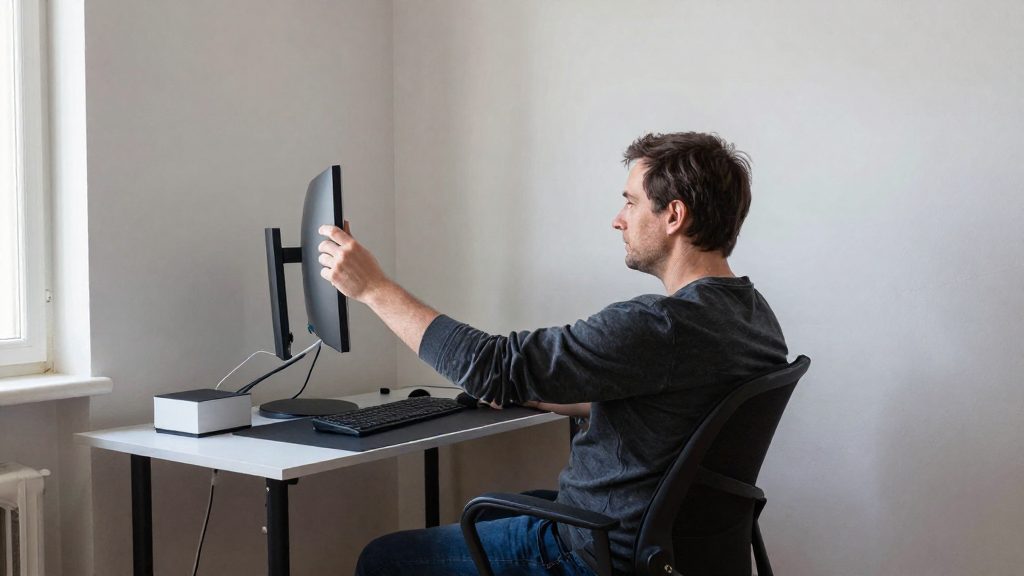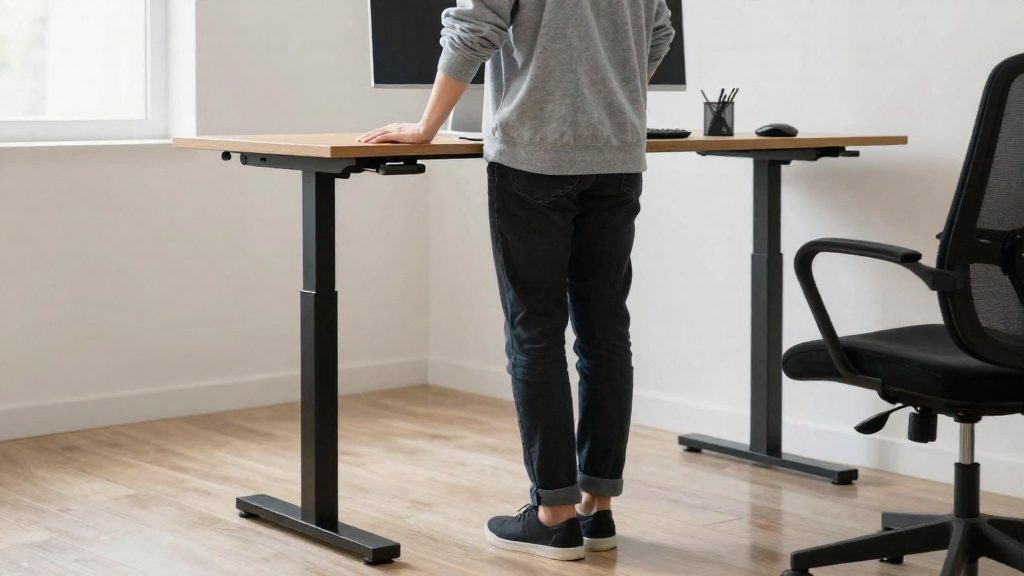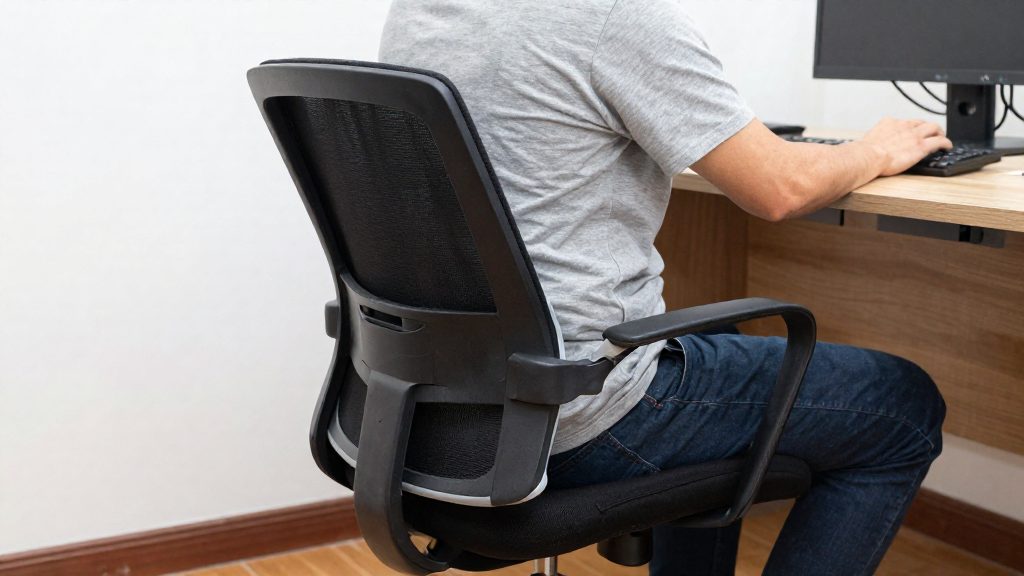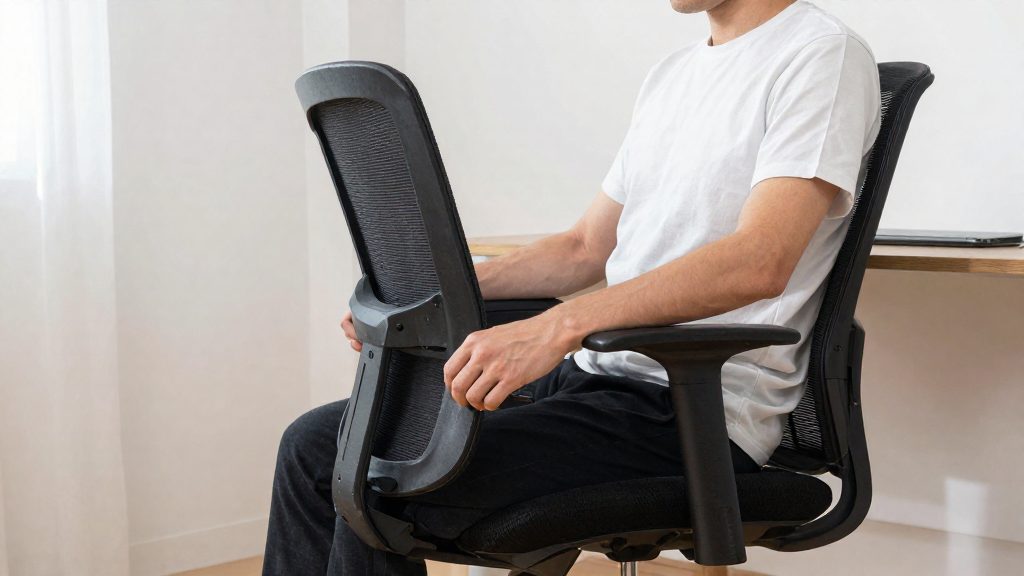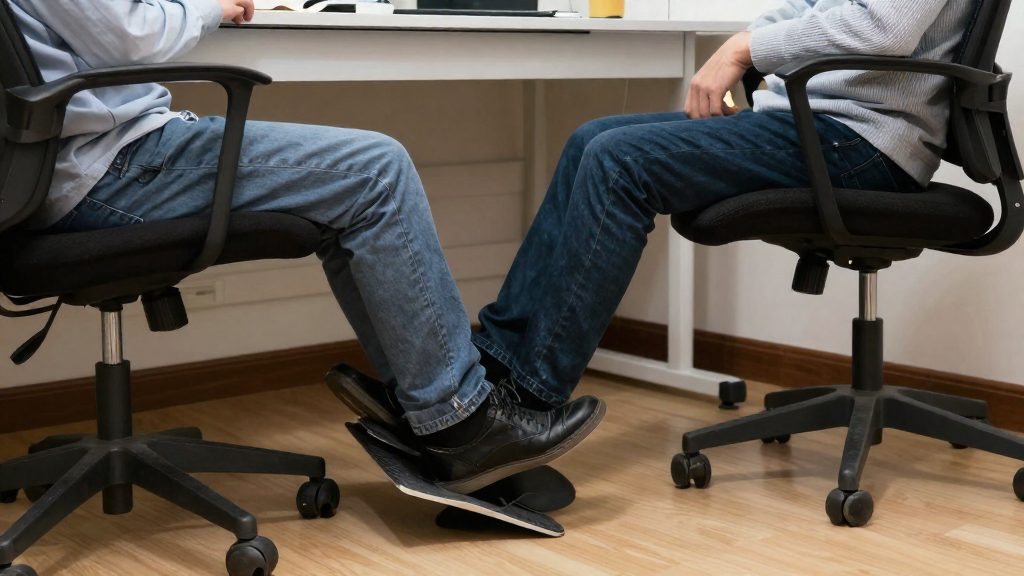
Your feet should rest flat on the floor while you work. The Canadian Centre for Occupational Health and Safety (CCOHS, 2025) advises sitting with both feet flat on the floor. When that isn’t possible, it recommends a footrest that supports both feet, so your legs stay in a stable, supported position at the desk.
Why do your feet need to touch the floor or a footrest?
Flat feet give your lower legs a stable base. The CCOHS (2025) also recommends checking the space between the front edge of the seat and your calves: a closed fist should fit through that gap, about 5 cm (2 in). This check confirms the seat depth leaves room for your legs.
The CCOHS (2022 and 2025) guidance on the lower body is summarized below.
| Checkpoint | CCOHS guidance (publication date) |
|---|---|
| Feet | Flat on the floor, or flat and firm on a footrest (2025) |
| Seat edge to calves | A closed fist fits through, about 5 cm / 2 in (2025) |
| Knees | At hip level or lower (2022) |
| Ankles | In front of the knees (2022) |
| Seat edge to back of knee | Three-finger gap (2022) |
When a footrest is needed
If your feet cannot rest flat on the floor, the CCOHS (2025) states that the footrest must be adjustable, support both feet, and let them rest flat and firmly. To set it up:
- Adjust the chair height so your knees sit at hip level or lower.
- Place the footrest and adjust its height until both feet rest flat and firmly on it.
- Check that your ankles sit in front of your knees.
- Check the three-finger gap between the back of your knee and the front edge of the seat.
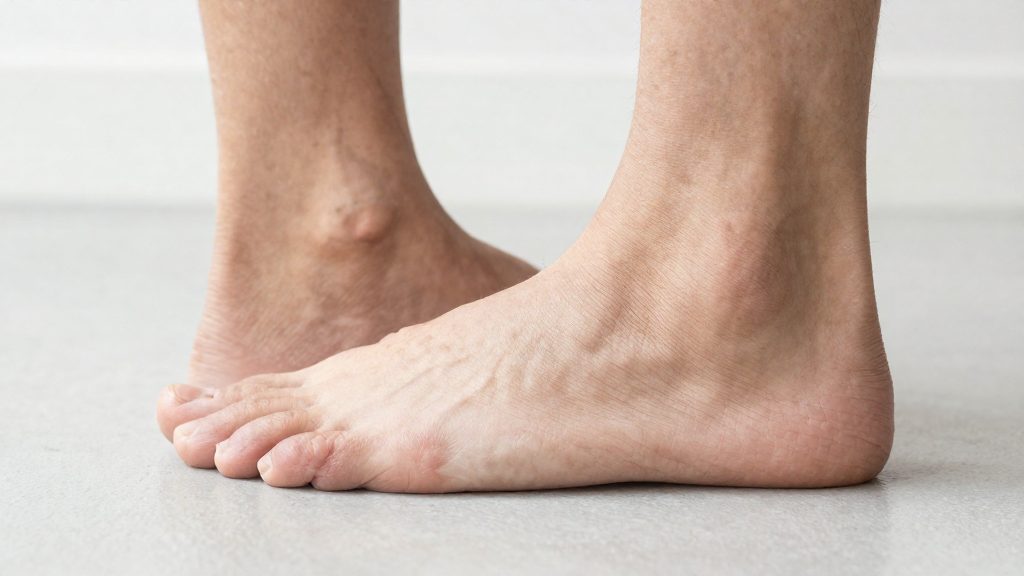
What a footrest does for shorter people
A footrest is useful when your feet cannot rest flat on the floor while you are seated. The Canadian Centre for Occupational Health and Safety (CCOHS, 2025) advises sitting with both feet flat on the floor and recommends a footrest when that position is not possible. Shorter people often run into this problem because the seat height needed to reach the desk leaves the feet unsupported.
Check your position in this order:
- Adjust the seat height first so that your feet reach the floor.
- If your feet still cannot rest flat, place a footrest under them.
- Check the gap between the front edge of the seat and your calves. According to CCOHS (2025), a closed fist should fit through this gap, which is about 5 cm (2 in).
- Check your knees. CCOHS (2022) advises keeping them at hip level or lower.
- Check your ankles. They should sit in front of your knees.
- Check the space behind your knees. CCOHS (2022) recommends leaving about three fingers’ width between the back of the knee and the front edge of the seat.
The CCOHS sets out specific requirements for a footrest:
| Requirement | CCOHS guidance (2025) |
|---|---|
| Adjustability | The footrest must be adjustable |
| Foot support | It must support both feet |
| Foot position | Both feet must rest flat and firmly on it |
Adjust the chair first
Chair height determines whether your feet can rest on the floor, so set the seat before anything else. The Canadian Centre for Occupational Health and Safety (CCOHS) advises sitting with feet flat on the floor. For a short person, the seat height that suits the desk may leave the feet off the floor. Lower the seat until both feet are flat if the desk height still works. If it does not, use an adjustable footrest, then check the rest of the setup.
To adjust the chair:
- Sit back fully in the chair and raise or lower the seat until both feet rest flat on the floor.
- Check the calf clearance. The space between the front edge of the seat and your calves should let a closed fist pass through, about 5 cm (2 in), according to CCOHS (2025).
- Check the under-knee clearance. Leave a gap of about three fingers between the back of your knee and the front edge of the seat, according to CCOHS (2022).
- Confirm that your knees sit at hip level or lower and that your ankles are in front of your knees, as CCOHS (2022) recommends.
| Check | CCOHS guidance |
|---|---|
| Foot position | Flat on the floor or on a footrest |
| Calf clearance | Closed fist fits, about 5 cm (2 in) |
| Under-knee clearance | About three fingers |
| Knee height | Hip level or lower |
| Ankle position | In front of the knees |
If your feet cannot rest flat on the floor at a seat height that suits your desk, CCOHS recommends a footrest. It should be adjustable, support both feet, and let them rest flat and firmly on it, according to CCOHS (2025).
How to Choose an Adjustable Footrest
A footrest is needed when your feet cannot rest flat on the floor. According to CCOHS (2025), you should first sit in your chair with both feet flat on the floor and check whether the gap between the front edge of the seat and your calves allows a closed fist (about 5 cm or 2 in) to pass. If your feet cannot rest flat on the floor, a footrest is the recommended solution. If a closed fist does not fit through the gap between the seat edge and your calves, the seat fit needs adjusting. Adjust the seat and recheck.
CCOHS (2025) specifies that the footrest must be adjustable, support both feet, and let them rest flat and firmly. A fixed footrest that is too high or too low for your height will not meet these criteria.
Use the following checks once the footrest is in place:
| Check | Recommended position | Source |
|---|---|---|
| Foot position | Flat on the floor or fully supported on the footrest | CCOHS (2022, 2025) |
| Knee height | At hip level or lower | CCOHS (2022) |
| Ankle position | In front of the knees | CCOHS (2022) |
| Gap at seat front | Closed fist (about 5 cm or 2 in) between seat edge and calves | CCOHS (2025) |
| Gap behind knee | Three fingers between the back of the knee and the seat front edge | CCOHS (2022) |
To adjust the footrest, follow these steps:
- Sit fully back in your chair and set the seat height so your feet can be positioned correctly.
- Place both feet on the footrest and check that they lie flat.
- Adjust the footrest height until your knees are at or below hip level.
- Confirm that the three-finger gap remains behind your knees.
- Recheck the fist gap at the seat front after any seat adjustment.
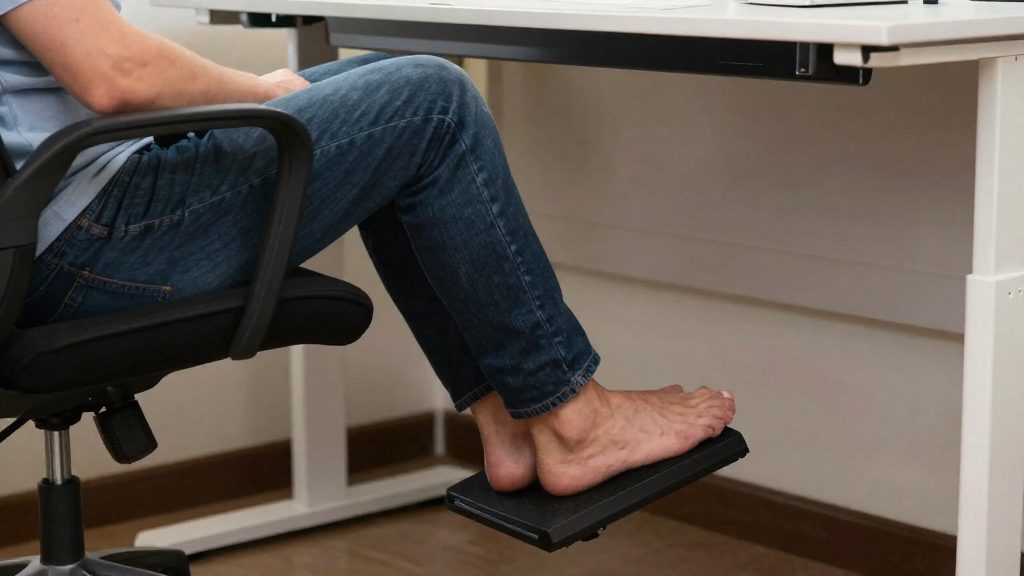
Common Mistakes to Avoid with a Footrest
According to the Canadian Centre for Occupational Health and Safety (CCOHS, 2025), a footrest is recommended when your feet cannot rest flat on the floor. A footrest that does not meet the CCOHS criteria (adjustable, supports both feet, feet flat and firm) will not do its job. The points below cover the most frequent errors and the CCOHS guidance that addresses each one.
Errors in use
- Using a footrest that is not adjustable. CCOHS (2025) states that the footrest should be adjustable, so that its height can match your seated position.
- Supporting only one foot. The footrest should support both feet.
- Resting the feet on the edge or with the heels lifted. The feet should lie flat and firmly on the footrest.
- Raising the knees above hip level. CCOHS (2022) advises keeping the knees at hip level or lower.
- Placing the ankles behind the knees. The ankles should be in front of the knees.
Errors in seat fit
Setting the footrest correctly does not compensate for a seat that presses on your legs. CCOHS (2025) recommends checking that a closed fist fits between the front edge of the seat and your calves, which is about 5 cm or 2 inches. CCOHS (2022) also recommends leaving a space of three fingers between the back of your knee and the front edge of the seat.
Quick self-check
- Place both feet flat on the floor or on the footrest.
- Check that your knees are at hip level or lower.
- Check that your ankles are in front of your knees.
- Slide a closed fist between the seat and your calves.
- Check that three fingers fit between the back of your knee and the seat edge.
| Check | CCOHS guidance |
|---|---|
| Foot support | Both feet flat and firm, on the floor or a footrest |
| Footrest type | Adjustable, supporting both feet (CCOHS, 2025) |
| Knee height | At hip level or lower (CCOHS, 2022) |
| Ankle position | In front of the knees (CCOHS, 2022) |
| Seat-to-calf gap | Room for a closed fist, about 5 cm or 2 inches (CCOHS, 2025) |
| Seat-to-knee gap | Three fingers between the back of the knee and the seat edge (CCOHS, 2022) |
Recheck your position each time you return to the desk
The reference positions from the Canadian Centre for Occupational Health and Safety (CCOHS, 2025 and 2022) can serve as a check at each return to the desk. The table below lists those positions in the order to check them.
| Body element | Reference position (CCOHS) |
|---|---|
| Feet | Flat on the floor, or flat and firmly placed on an adjustable footrest |
| Knees | At hip level or lower |
| Ankles | In front of the knees |
| Gap between seat edge and calves | Room for a closed fist, about 5 cm (2 in) |
| Gap behind the knees | Three fingers’ width between the back of the knee and the front edge of the seat (CCOHS, 2022) |
A footrest matters most for short users, because it compensates for a seat height that leaves the feet unsupported. The CCOHS specifies that it must be adjustable and support both feet, with each foot resting flat and firmly. Set the seat height first, then adjust the footrest so that both feet rest flat and the knees stay at hip level or lower.
To move during a break, change posture within these reference ranges instead of leaving them. Gentle leg and ankle movements while seated, and small changes in trunk position, keep the body moving without forcing the knees above hip level or pushing the feet off the footrest. When you resume work, run through the table again: feet flat, knees at hip level or lower, ankles forward, and the seat-edge gap rechecked.
The official sources consulted do not specify a stretching routine, the duration of breaks, or how often to take them.
Frequently asked questions
Do I need a footrest if my feet already reach the floor?
Not necessarily. The Canadian Centre for Occupational Health and Safety (CCOHS, 2025) advises sitting with both feet flat on the floor, and a footrest is the option to use only when that position can’t be reached.
How can I tell if my footrest is at the right height?
Your footrest is set correctly when both feet rest flat and firmly on it, your knees sit at hip level or lower, and your ankles stay in front of your knees. CCOHS (2022) also describes a three-finger knee-to-seat gap between the back of your knee and the front edge of the seat.
Does a footrest replace adjusting the chair?
No. Knee and ankle positions depend on seat height and seat depth, so you set the chair first and use the footrest only to close the remaining distance between your feet and the floor.