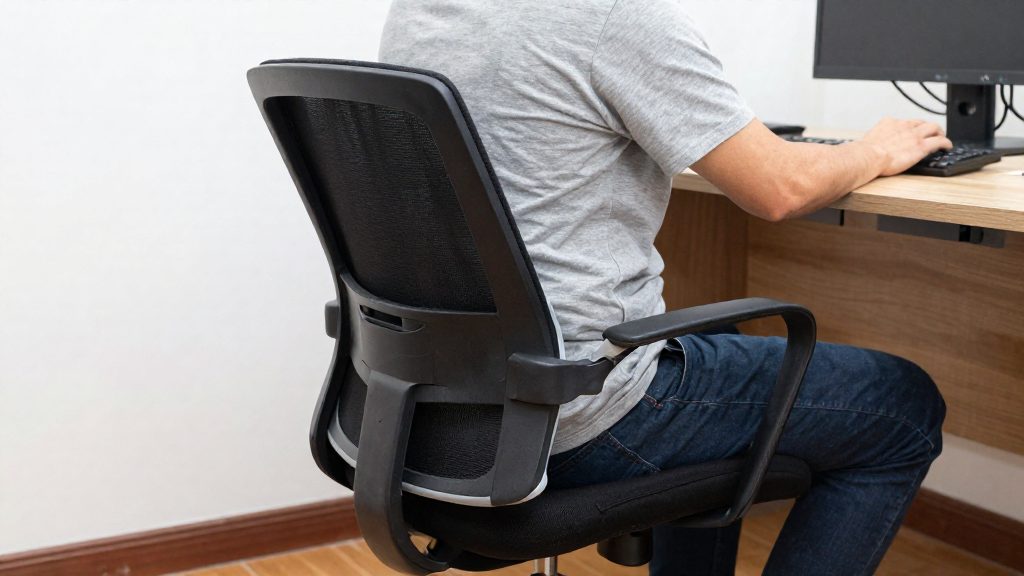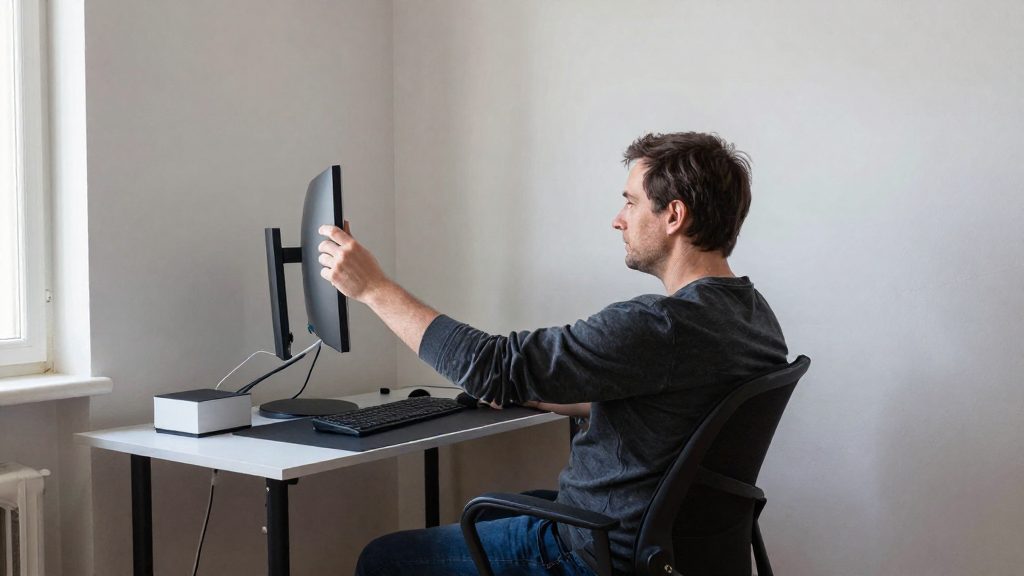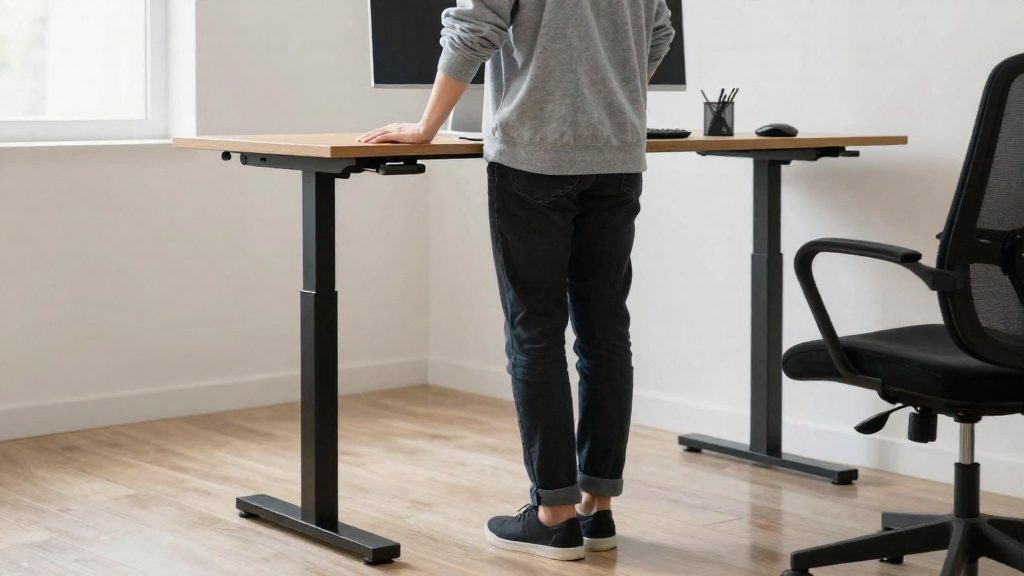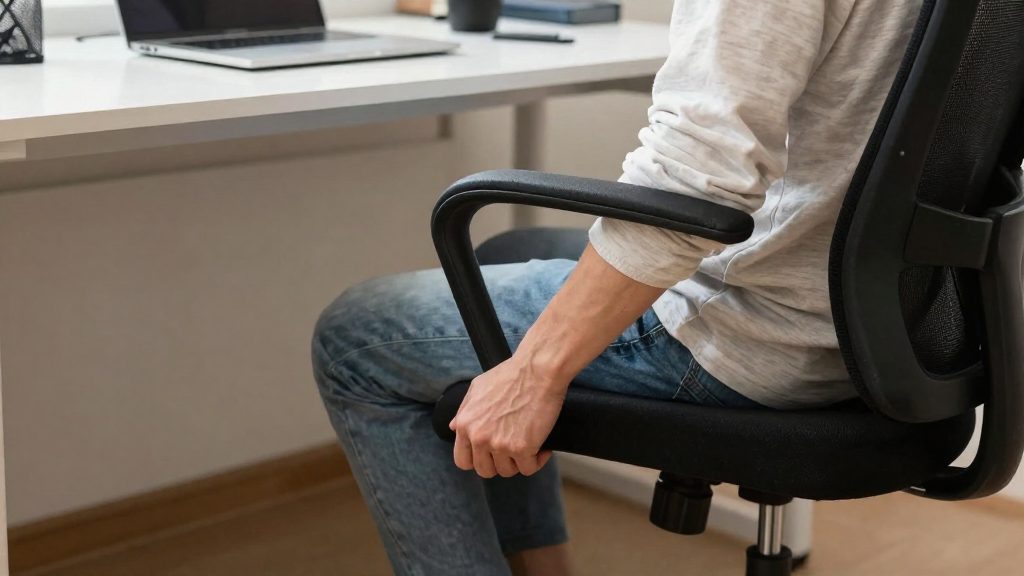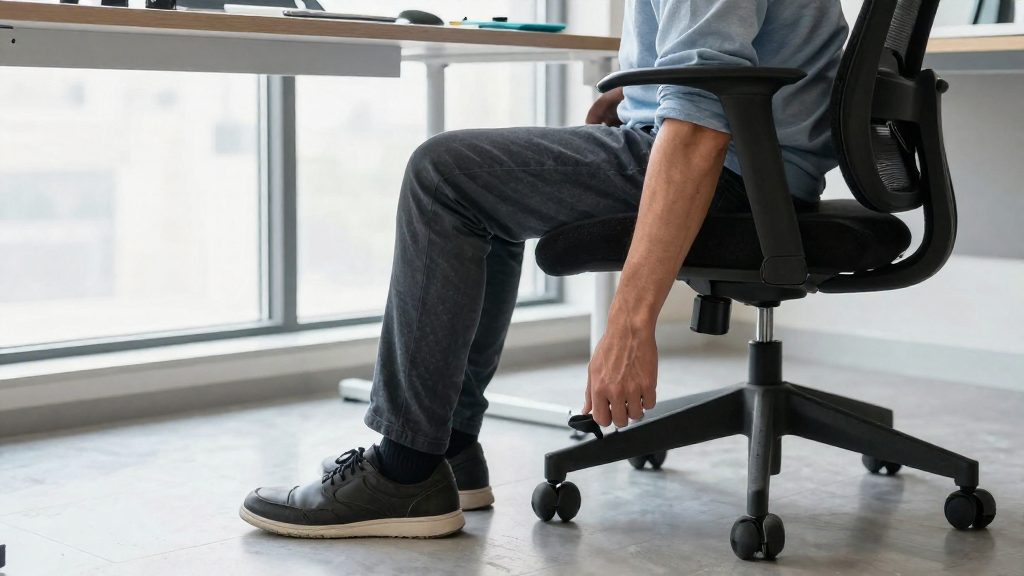
Seat depth determines whether you can sit with your back against the backrest while the front edge of the seat stays clear of the back of your knees. For shorter legs, a seat set too deep is a common fit problem. The official sources consulted specify that the seat should let you use the backrest without the front edge pressing on the back of your knees (UCLA Health). The CCOHS (Canadian Centre for Occupational Health and Safety) adds that the seat should not press on the back of the thighs or knees either.
Why seat depth matters when your legs are short
Seat depth is the distance from the backrest to the front edge of the seat pan. If that distance is longer than your thigh allows, you must either sit forward, away from the backrest, or press the front edge into the back of your knees. Both positions reduce the support your back gets from the chair.
The CCOHS describes a usable fit with your feet flat on the floor:
| Check | What to look for |
|---|---|
| Front clearance | Room between the front edge of the seat and your calves, about a fist’s width (roughly 5 cm or 2 inches) |
| Pressure on thighs and knees | None on the back of the thighs or knees |
| Backrest contact | You can lean back and use the backrest without the front edge pressing on the back of your knees (UCLA Health) |
To shorten the seat, check whether your chair has an adjustable seat pan. UCLA Health notes that these chairs usually have a lever under the front of the seat. Slide the pan forward or back, then sit fully back and repeat the clearance check.
If the seat cannot be adjusted far enough, UCLA Health notes that a lumbar pillow can reduce the effective seat depth when the seat is too deep. If your feet still cannot rest flat, for example at a fixed-height desk, the CCOHS recommends an adjustable footrest that supports both feet.
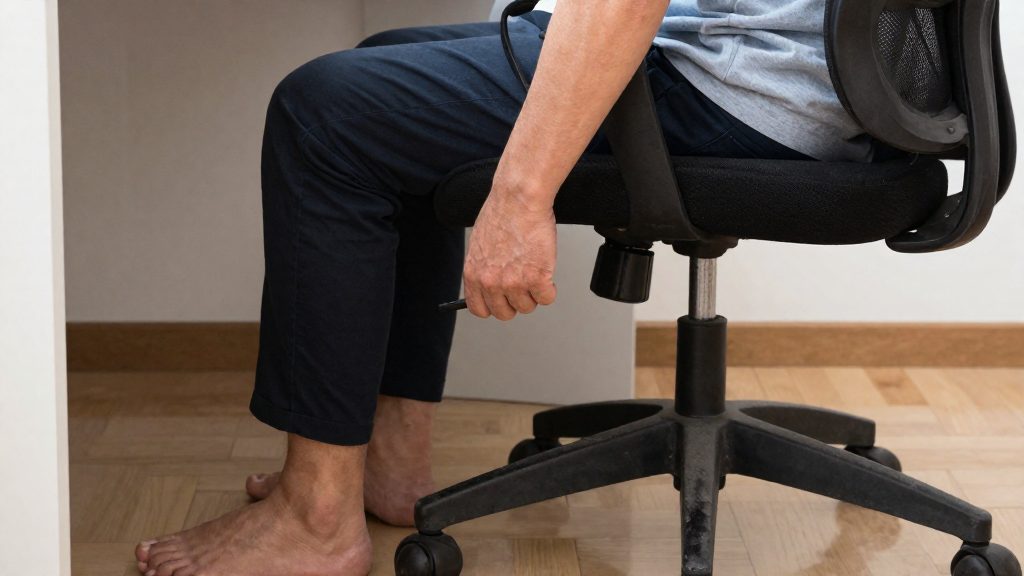
How to tell if the seat is too deep
A seat that is too deep can prevent short-legged users from using the backrest properly. To check, sit with your lower back against the backrest and both feet flat on the floor, then look at the front edge of the seat. UCLA Health states that you should be able to use the backrest without the front edge pressing on the back of your knees. The CCOHS adds that the seat should not put pressure on the back of your thighs or knees.
Run the check in this order:
- Sit fully back so your lower back touches the backrest.
- Keep both feet flat on the floor.
- Slide your hand between the front edge and the back of your knee, then between the front edge and your calves.
- Note whether you feel pressure on the back of your thighs or knees.
The CCOHS describes the correct clearance between the front edge and your calves as about a fist’s width (roughly 5 cm or 2 inches) with the feet flat. A gap much smaller than that, or no gap at all, points to a seat that is too deep.
| Check | Correct setting | Sign the seat is too deep |
|---|---|---|
| Back contact | Back rests on the backrest with knees clear of the front edge | Leaning back pushes the front edge into the back of the knees |
| Calf clearance (feet flat) | About a fist’s width (roughly 5 cm or 2 inches), per the CCOHS | Little or no gap |
| Thigh and knee pressure | No pressure on the back of the thighs or knees, per the CCOHS | Pressure felt behind the knees or thighs |
| Lumbar pillow | Not needed when the seat depth fits | UCLA Health notes a lumbar pillow can reduce the effective seat depth if the seat is too deep |
If the check fails, look for a lever under the front of the chair. UCLA Health notes that chairs with an adjustable seat pan usually have one there. If your chair has no such lever, the seat depth cannot be changed from the chair itself.
How to adjust seat depth step by step
Adjusting seat depth on an office chair means sliding the seat pan forward or back until your legs are supported without the front edge pressing into them. For short legs, this usually means moving the seat pan back toward the backrest, only as far as you need to clear the back of your knees. The CCOHS and UCLA Health both describe the same goal: you should be able to use the backrest without the front edge pressing on the back of your knees or thighs.
Seat depth is the distance from the backrest to the front edge of the seat. Seat pan adjustment is the mechanism that changes this distance, usually a lever under the front of the chair. Clearance is the gap between the front edge and your calves when your feet are flat on the floor.
- Set seat height first. According to the CCOHS, stand in front of the chair and set the highest point of the level seat just below your kneecap, then sit with your feet flat.
- Locate the seat pan lever. UCLA Health notes that chairs with an adjustable seat pan usually have a lever under the front of the chair.
- Sit back fully against the backrest, as you would when working.
- Check the front edge. If it presses on the back of your knees, the seat is too deep for you.
- Adjust the depth. Release the lever, slide the seat pan forward or back, then lock it in place.
- Re-test with the backrest in use. Confirm that the front edge does not press on the back of your knees and that you can lean back without shifting forward.
| Check | Target | Source |
|---|---|---|
| Clearance between front edge and calves (feet flat) | About a fist’s width (roughly 5 cm or 2 in) | CCOHS |
| Pressure on back of thighs or knees | None | CCOHS |
| Front edge while using backrest | Does not press on back of knees | UCLA Health |
If your feet cannot rest flat on the floor after adjusting depth, the CCOHS recommends an adjustable footrest that supports both feet. If the seat pan cannot be shortened enough, UCLA Health notes that a lumbar pillow can reduce the effective seat depth, which may help when the seat is too deep.
Set the seat height first
Set the seat height before you touch the seat depth. Height determines how your feet and knees sit relative to the seat, so set it first, then take the front-edge reading. According to CCOHS (Canadian Centre for Occupational Health and Safety), you set the height while standing in front of the chair: adjust it so the highest point of the seat sits just below your kneecap. Measuring from your own knee rather than from the chair’s scale gives a height that fits your leg length.
Once the height is set, sit down with both feet flat on the floor and check the gap at the front edge of the seat. CCOHS describes the space between the front edge and your calves as about a fist’s width, roughly 5 cm or 2 inches. A gap much smaller than that suggests the seat is too high or too deep for your legs. A gap much larger than that suggests the seat is shallower than you need, so recheck the height and the depth setting.
CCOHS also states that the seat should not press on the back of your thighs or knees. Pressure in that area is a sign the seat does not fit your legs, whatever the height setting.
| Check | Target | Source |
|---|---|---|
| Seat height (standing) | Highest point of seat just below kneecap | CCOHS |
| Front-edge gap (seated, feet flat) | About a fist’s width, roughly 5 cm / 2 in | CCOHS |
| Pressure at back of thighs and knees | None | CCOHS |
| Backrest use | Front edge does not press behind the knees | UCLA Health |
If your feet cannot rest flat, for example at a fixed-height desk, CCOHS recommends an adjustable footrest that supports both feet. Set the footrest first, then take the front-edge reading.
UCLA Health adds a check with the backrest. Lean back fully and confirm the front edge does not press against the back of your knees. If it does, the seat is too deep for you. UCLA Health also notes that a lumbar pillow can reduce the effective seat depth when the seat is too deep. On chairs with an adjustable seat pan, the depth lever is usually located under the front of the chair.
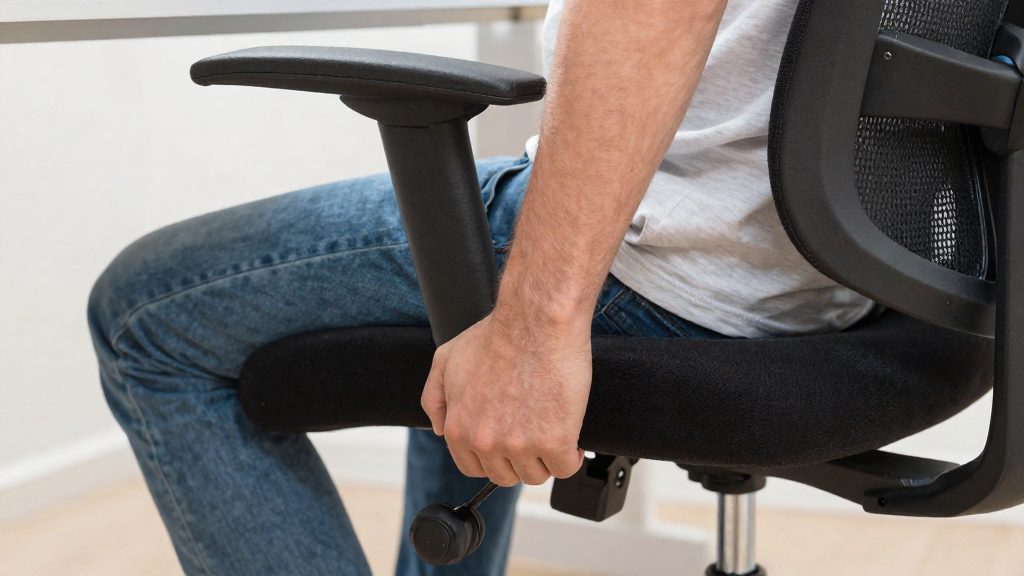
How much space to leave behind the knees?
The CCOHS describes the right clearance at the front of the seat as about a fist’s width, roughly 5 cm or 2 inches, between the front edge and the calves when both feet rest flat on the floor. For short legs, this gap is the main test of seat depth. A gap much smaller than that, or no gap at all, usually means the seat is too deep for your leg length. A front edge that presses on the calves or the back of the knees means the seat is too deep for you, or the seat pan is too far forward.
Use the table below to check each point after you adjust the chair:
| Check | Target | Source |
|---|---|---|
| Gap between seat edge and calves, feet flat | About a fist’s width (roughly 5 cm / 2 in) | CCOHS |
| Pressure on the back of the thighs and knees | None; the seat should not press there | CCOHS |
| Use of the backrest | Possible without the front edge pressing behind the knees | UCLA Health |
If the seat is too deep, the adjustment depends on the chair. Chairs with an adjustable seat pan usually have a lever under the front of the seat, which UCLA Health identifies as the control to use. If the chair has no seat-depth adjustment, UCLA Health notes that a lumbar pillow can reduce the effective seat depth, letting you reach the backrest without the front edge touching the back of your knees.
Short legs often cannot reach the floor on a chair set to a comfortable height for the desk. In that case, the CCOHS recommends an adjustable footrest that supports both feet, rather than letting the feet hang or raising the seat past the point where the front edge contacts the thighs.
What to do if the chair has no seat depth adjustment?
If your chair has a fixed seat pan, you cannot change its depth, so you adjust the rest of your setup around it. Before accepting that, check for a seat pan lever. UCLA Health notes that chairs with an adjustable seat pan usually have this lever under the front of the chair. If you find none, the seat depth is fixed, and the fit test below shows whether it works for you.
Test whether a fixed seat fits
- Sit with your back fully against the backrest.
- Check that the front edge does not press on the back of your thighs or knees. The CCOHS says the seat should not put pressure there.
- With your feet flat, check the gap between the front edge and your calves. The CCOHS describes roughly a fist’s width, about 5 cm (2 inches).
- Confirm you can use the backrest without the front edge pressing behind your knees, as UCLA Health recommends.
If the seat fails step 2 or 4, use one of the workarounds below.
Workarounds for a fixed-depth seat
| Option | How it helps | Limit |
|---|---|---|
| Lumbar pillow | Reduces the effective seat depth, according to UCLA Health | The seat itself is unchanged |
| Adjustable footrest | Supports both feet when they cannot rest flat, according to the CCOHS | Relevant mainly when a fixed-height desk leaves your feet without floor contact |
When to use a footrest?
A footrest is needed when your feet cannot rest flat on the floor with the seat set correctly. According to the CCOHS (Canadian Centre for Occupational Health and Safety), you should first set the seat height by standing in front of the chair and adjusting the highest point of the level seat to sit just below the kneecap. Then sit down with your feet flat and check the space at the front edge of the seat. The CCOHS describes about a fist’s width (roughly 5 cm or 2 inches) between the seat edge and your calves.
If your feet cannot rest flat, for example at a fixed-height desk, the CCOHS recommends an adjustable footrest that supports both feet. The footrest should let you change its angle or height so that your feet are fully supported and your knees are not forced above the level of your hips.
Seat depth affects this decision as well. UCLA Health states that the seat should let you use the backrest without the front edge pressing on the back of your knees. If the seat is too deep, a lumbar pillow can reduce the effective seat depth. Chairs with an adjustable seat pan usually have a lever under the front of the chair.
| Situation | Recommended action |
|---|---|
| Feet rest flat, with about a fist’s width between the seat edge and the calves | No footrest needed; keep the seat height as set |
| Feet cannot rest flat on the floor (for example, at a fixed-height desk) | Use an adjustable footrest that supports both feet |
| Front edge of the seat presses on the back of the knees | Adjust seat depth (lever under the seat pan, if available) or add a lumbar pillow to reduce effective depth |