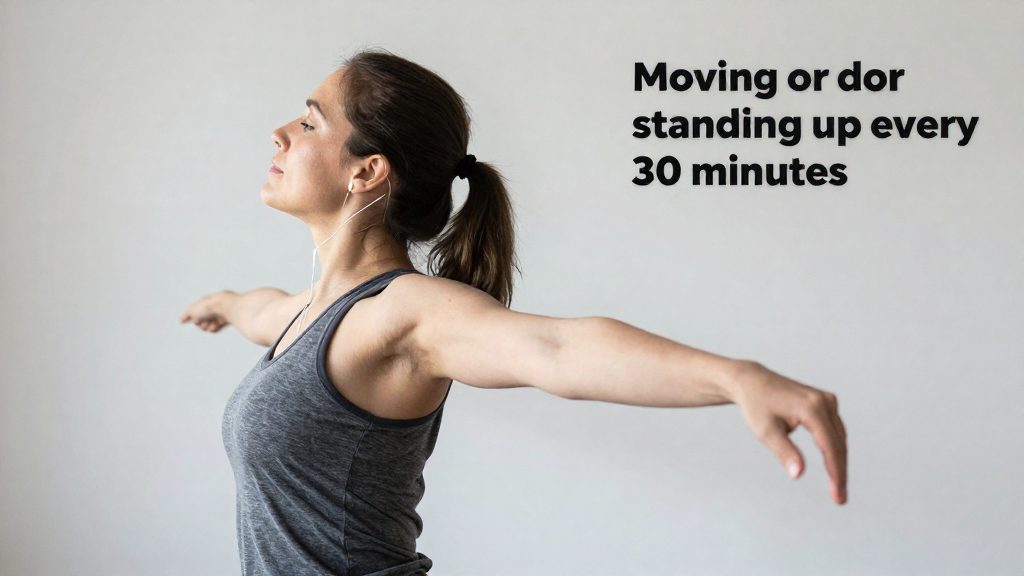
Interrupt your sitting roughly every 30 minutes. In a randomized trial of 49 inactive women office workers, standing or moving for 1–2 minutes every half hour cut workday sedentary time by about 36 minutes. A Western University study prompted office workers to take 2–3 minute breaks every 30–45 minutes, and break frequency rose while total sitting time fell over four weeks. Both studies point toward short, frequent breaks, but neither was designed to separate the effect of frequency from the effect of break length.
How often should you take breaks from sitting?
Recommended interval: roughly every 30 minutes of sitting
The trial used a 30-minute interval, and the Western study used a range of 30 to 45 minutes. A 30-minute target is the tighter option and matches the interval used in the Kansas State trial. Where a 30-minute prompt is hard to maintain, a 45-minute interval is the upper bound used in the Western study.
Why continuous sitting, not total hours, sets the interval
The studies prompted regular interruptions of sitting, and in the Western study total sitting time also fell. They do not show that uninterrupted sitting matters more than total hours. Each short break resets the period of continuous sitting, which is why the schedule is defined by the interval between breaks.
Tallying your daily sitting time to set a personal schedule
To choose an interval that fits your day, record your sitting for one typical workday:
- Note the time each time you sit down and stand up.
- Calculate the length of each uninterrupted sitting block.
- Count how many blocks last longer than 30 minutes.
- Set your reminder at the interval that matches your longest common block, starting at 30 minutes.
Repeat the tally after one or two weeks. If you still exceed 30 minutes most days, keep the 30-minute reminder. If you cannot sustain it, use 45 minutes at most, as in the Western study. The studies do not cover intervals outside 30–45 minutes.
What does the research say about short, frequent breaks?
Two studies offer the most direct evidence on frequent short breaks in office settings. Both measured how often workers interrupted sitting and what changed in their sedentary time. One also measured fasting blood glucose. Together, they show that frequent short breaks produce measurable changes, though neither study establishes a single optimal interval.
Kansas State University randomized trial (2016)
Published in Preventive Medicine Reports and available via PMC (dated 2016-08-09), this randomized trial enrolled 49 inactive women office workers. Participants who stood or moved for 1–2 minutes every half hour cut their workday sedentary time by about 36 minutes.
The trial also measured fasting blood glucose. A drop appeared only in the short-break group. The study population was limited to inactive women, so these results apply to that group and should not be assumed to hold for all office workers without further evidence.
Western University study (2023)
A Western University study, reported by Western News on 2023-09-19, asked office workers to take 2–3 minute breaks every 30–45 minutes. Over four weeks, break frequency rose and total sitting time fell. This study measured sitting time only, not glucose, so it confirms the behavioral change without showing a metabolic effect.
| Study | Year | Participants | Break prompt | Measured result |
|---|---|---|---|---|
| Kansas State University (Preventive Medicine Reports) | 2016 | 49 inactive women office workers | 1–2 min standing or moving every 30 min | Workday sedentary time reduced by about 36 min; fasting blood glucose fell only in the short-break group |
| Western University (Western News) | 2023 | Office workers | 2–3 min breaks every 30–45 min over four weeks | Break frequency rose; total sitting time fell |
Are longer breaks just as effective?
For the outcomes measured in these studies, no. In the randomized trial from Kansas State University, two planned 15-minute breaks per day produced no meaningful change in sedentary time during the workday.
A Western University study reached a similar conclusion from a different design. The researchers concluded that longer breaks are not needed for significant health gains.
The scheduling trade-off is mainly about how long you sit between interruptions. One long break leaves the rest of the day without planned movement, while several short breaks interrupt sitting more often. The results above are consistent with short, frequent breaks working, but these studies did not isolate frequency from total break time or test every possible schedule. Choose the schedule you can keep consistently, because a pattern you abandon after a week gives you none of the measured effects.
How long should each break last?
The data points to short breaks. The target duration for a sitting break is 1 to 3 minutes. The two studies in the data sheet tested two bands within that range: 1 to 2 minutes and 2 to 3 minutes. The Kansas State trial also compared two planned 15-minute breaks per day, which produced no meaningful change in sedentary time.
The duration matches the movement. A break of 1 to 3 minutes is long enough to stand up, walk a short distance, or shift position, which is what the trial participants did. The sheet does not describe the exact movements in the Western University study, so you should not assume a specific routine from it.
Keep each break short enough that you return to your task without losing your place. Keeping each break short matches the durations tested in the studies and makes it easier to return to your task.

What can you do during a sitting break?
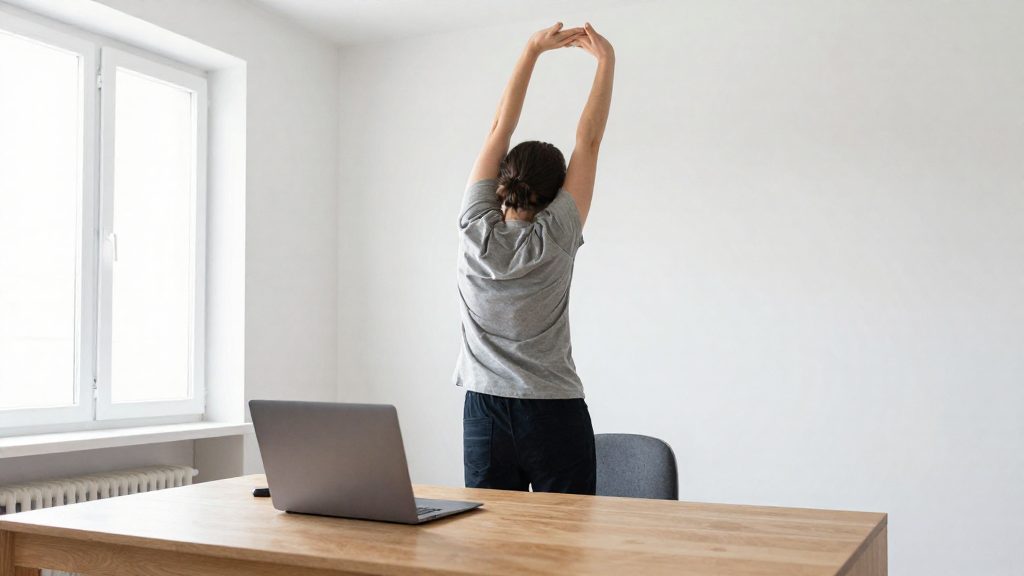
A sitting break can be a short sequence of standing, walking, and mobility movements done at or near your desk. The movements below target the areas that tend to stiffen during long periods of sitting.
Standing up and walking is the simplest interruption. Rise from your chair, stand tall with your weight even on both feet, and walk for a short distance. No equipment is needed.
Gentle calf raises activate the calf muscles and add movement to the lower legs. Stand behind your chair, hold the backrest for balance, lift your heels slowly, and lower them with control.
Other movements, performed in a controlled way:
- Neck tilts: Slowly bring one ear toward the shoulder, keeping the shoulders relaxed. Repeat on the other side.
- Shoulder rolls: Lift the shoulders toward the ears, roll them back and down, and release.
- Chest openers: Clasp your hands behind your back, straighten your arms, and draw your shoulder blades together.
- Seated torso twists: Sit tall, hold the sides of the chair back, and rotate your upper body gently to one side while keeping your hips facing forward.
- Hip flexor stretches: Stand beside your chair, step one foot back, and shift your hips slightly forward until you feel a stretch at the front of the back hip. Keep your torso upright.
| Movement | Main area it targets |
|---|---|
| Standing up and walking | Hips and legs, overall sitting interruption |
| Gentle calf raises | Calf muscles and lower legs |
| Neck tilts | Side of the neck |
| Shoulder rolls | Shoulders and upper back |
| Chest openers | Chest and front of the shoulders |
| Seated torso twists | Mid-back and waist |
| Hip flexor stretches | Front of the hip |
How can you remember to move at a desk?
Focused work often makes people lose track of time while seated, so a reminder is the simplest way to interrupt sitting at regular points. The method you choose determines how reliably you act on a prompt.
Recurring timers on a phone or computer
A recurring alert repeats automatically, unlike a one-time alarm that you must reset each time. Most phones and operating systems let you set a repeating timer or reminder. Choose a short notification that tells you to stand up, and dismiss it only after you have moved. A timer on a device you already use, such as your phone or computer, requires no account or additional software.
Pairing breaks with existing routines
A routine cue attaches the break to an action you already perform every day, such as making coffee, collecting a printout, or ending a call. The existing action becomes the trigger, so no separate reminder is needed. This method works best when the routine happens at a predictable point in your day. If your routine occurs less often than you would like, combine it with a timer.
Calendar reminders and shared team prompts
Recurring calendar events, supported by tools such as Google Calendar and Microsoft Outlook, place the break directly in your schedule. You can label the event clearly, for example “stand and walk.” When several people work together, a shared prompt, such as a group channel message or a team-wide recurring reminder, makes breaks a visible norm rather than an individual decision. This reduces the feeling of stepping away alone.
| Method | How to set it up | Main strength | Main limitation |
|---|---|---|---|
| Recurring phone or computer timer | Repeating alert on a device you already use | Works without an account or extra software | Easy to dismiss without moving |
| Existing routine | Link the break to a daily action such as making coffee | Needs no device | Only as frequent as the routine itself |
| Calendar reminder | Recurring event in a calendar app | Visible in your schedule and easy to share | Only works if you check the calendar |
| Shared team prompt | Group channel message or team-wide recurring reminder | Makes breaks a shared norm | Requires agreement from the whole team |
Does a standing desk replace breaks?
A standing desk does not replace movement breaks. Standing changes your posture, but it does not provide the muscle activity and joint motion that walking provides. A sit-stand desk is most useful as one position among several, used alongside short periods of movement.
Why standing still differs from moving
Standing still is not the same as moving. Standing keeps the legs and trunk under a static load, a sustained, low-level effort without joint motion. Walking alternates muscle contraction and relaxation and moves the joints through their range. The randomized trial conducted at Kansas State University, with 49 inactive women office workers, had participants either standing or moving. The published summary groups these two behaviors together, so it cannot show how much of the effect came from standing alone. Standing at the desk should not be assumed to count as a break.
| Position | Body demand | Main limit |
|---|---|---|
| Seated | Low muscle activity; sustained load on the spine | Long periods without any change of position |
| Standing still | Sustained static load on legs, feet and lower back | Fatigue and discomfort build without movement |
| Standing with walking or movement | Muscle contraction and joint motion | Requires leaving or moving at the workstation |
Sit-stand desks as a complement
A sit-stand desk makes it easier to change position without leaving the workstation. It works best when used to vary posture:
- Alternate between sitting and standing across the workday instead of staying in one position.
- Set the work surface so your elbows and wrists stay relaxed while typing.
- Follow a standing period with a short walk or movement rather than extending the time spent standing still.
Limits of prolonged standing
Prolonged standing has its own load. Standing for long periods without moving can cause discomfort in the feet, legs and lower back, even though no strenuous work is being done. Standing is therefore a change of load, not a rest. Shift your weight between both feet, rest one foot slightly forward, and sit down when fatigue appears.
Frequently asked questions
How often should I stand up if I sit most of the day?
Aim for a break about every 30 minutes. In the Kansas State trial, standing or moving for 1–2 minutes every half hour was enough to cut workday sedentary time by about 36 minutes.
Do I need longer breaks, such as a 15-minute pause?
Not according to these studies. Two planned 15-minute breaks per day produced no meaningful change in the Kansas State trial, and the Western University researchers concluded that longer breaks are not needed for significant health gains.
Do short breaks protect my health over a full workday?
The evidence is limited. In the Kansas State trial, only the short-break group showed a drop in fasting blood glucose, but neither study tested break frequency against break length directly, so the best interval remains unconfirmed.