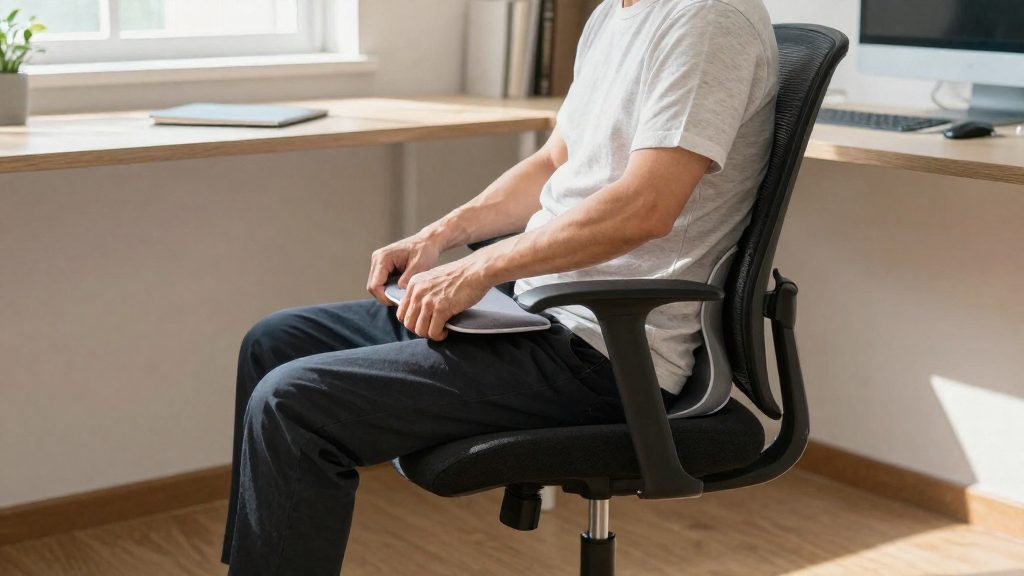
Why does sitting all day hurt your lower back?
Inactivity and static load as the core mechanism
Hinge Health identifies five causes of lower back pain from prolonged sitting. Two of them describe how the sitting itself loads the back:
- Inactivity: the muscles that support the spine are not moved, so they receive no regular change in load.
- Fatigue from static muscle load: holding the same position keeps the same muscles contracting for hours, and this fatigue accumulates over the day.
Hinge Health also cites Penn State researchers who found that switching positions every 15 minutes could relieve sitting-related lower back pain. The finding suggests that changing position regularly may help relieve sitting-related lower back pain.
Desk work as a recognized job-related risk
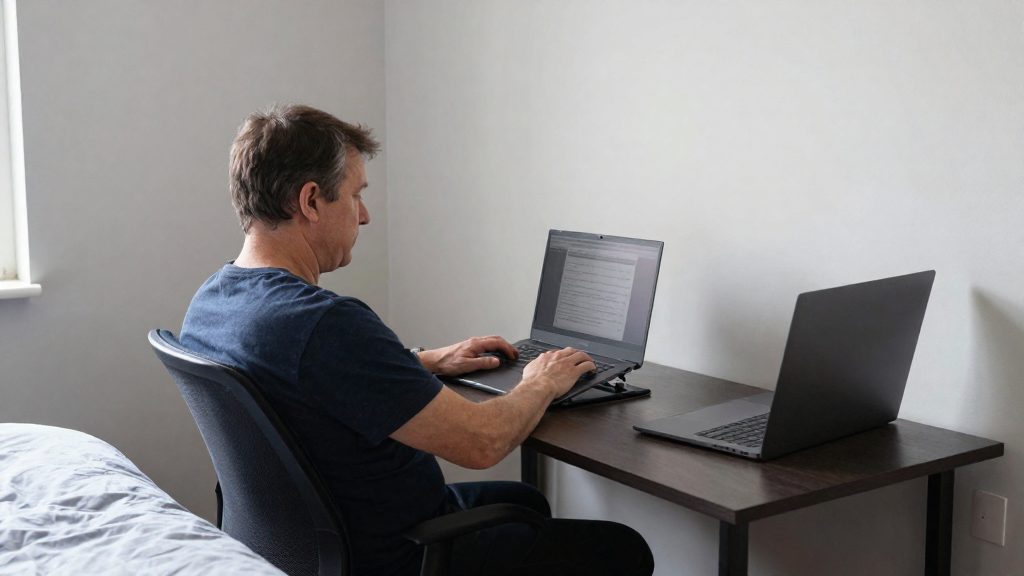
NIAMS (NIH) lists desk work among job-related risk factors for back pain. The source names two conditions that make the risk worse: poor posture, and sitting all day in an uncomfortable chair. Both conditions are common in office and home-office setups, which is why the risk applies to remote work as well as to traditional offices.
How the four load types relate to sitting
CDC/NIOSH lists four causes of musculoskeletal disorders in general. Awkward postures and sustained force are the ones most relevant to desk work:
| Load type (CDC/NIOSH) | What the source says |
|---|---|
| Sudden or sustained force | Listed as a cause of musculoskeletal disorders |
| Vibration | Listed as a cause |
| Repetitive motion | Listed as a cause |
| Awkward postures | Listed as a cause, alongside poor posture in NIAMS guidance |
The same source describes an ergonomics program as a systematic process for identifying and controlling workplace risk factors, including equipment designed to fit the worker.
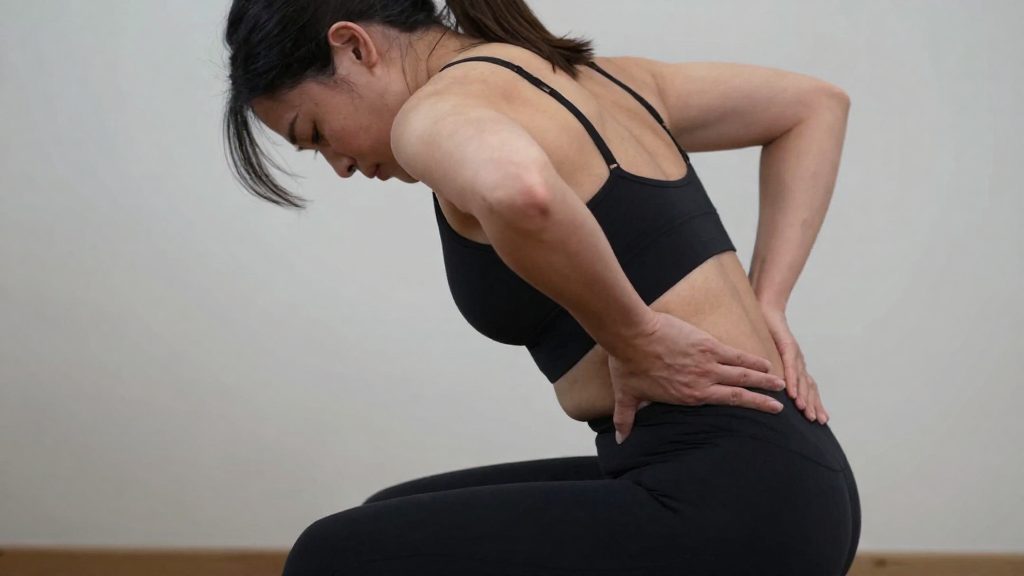
Posture and disc load: what actually happens
Seated work loads the lower spine differently from standing. Hinge Health lists higher pressure on the lower-spine discs as a direct cause of lower back pain from prolonged sitting. The discs sit between the vertebrae and absorb load, so the strain builds in this region over time. The source gives no pressure values, so this section does not quantify the difference.
Posture changes how much strain the discs and surrounding tissues take. Hinge Health states that slouching and forward lean strain the discs, ligaments and muscles. CDC/NIOSH also identifies awkward postures and sustained force as causes of musculoskeletal disorders, including disorders of the spinal discs.
| Posture or condition | Tissues named as strained or affected |
|---|---|
| Slouching | Discs, ligaments, muscles (Hinge Health) |
| Leaning forward | Discs, ligaments, muscles (Hinge Health) |
| Awkward postures or sustained force | Musculoskeletal disorders, including spinal disc disorders (CDC/NIOSH) |
When the same muscles stay contracted in one position, they tire. The sources list this fatigue as a cause of lower back pain but do not describe how load is redistributed.
Taken together, the sources describe three linked factors: higher baseline disc pressure while seated, added strain when the upper body slumps or leans forward, and fatigue from holding those postures. The sources in this section do not give exact thresholds for when strain begins, so the practical takeaway is to avoid prolonged slouching or forward lean rather than to aim for a specific angle.
Muscle imbalances: tight hips and a weak core
Long sitting sessions create a muscle imbalance around the pelvis and spine. Hinge Health lists tight hip flexors together with weaker core and back muscles as a cause of lower back pain from prolonged sitting. Hinge Health lists tight hip flexors together with weaker core and back muscles as a cause of lower back pain from prolonged sitting.
NIAMS notes that back pain is more common among people who are not physically fit, and that weak back and stomach muscles may not support the spine well. The core, which includes the abdominal and back muscles, is the group that holds the trunk upright. When it is weak, it may not support the spine well, according to NIAMS.
A static load occurs when a muscle holds a fixed position for a long time without moving, as happens when you keep the same sitting posture for hours.
| Muscle group | Condition during prolonged sitting | Documented effect |
|---|---|---|
| Hip flexors (front of the hip) | Held in a shortened position for hours | Tight hip flexors are linked to lower back pain from sitting (Hinge Health) |
| Abdominal (stomach) muscles | Little active use when seated | May not support the spine well when weak (NIAMS) |
| Back muscles | Little active use when seated | May not support the spine well when weak (NIAMS) |
| Postural muscles | Hold a fixed position for long periods | Cause fatigue from static load (Hinge Health) |
These sources do not provide a self-test for muscle imbalance. If pain persists, a healthcare professional or physical therapist can assess it.
Other risk factors beyond the chair
Sitting all day loads the lower back mechanically, but several non-mechanical factors also affect how often and how severely the pain occurs. NIAMS (NIH) identifies body weight, age, and sleep and mood among these contributors. They add to the effect of posture and sitting time rather than replacing it, so two people with the same desk routine may have very different pain patterns.
| Factor | What the sources report | Source |
|---|---|---|
| Body weight | Weight gain and obesity add stress to the back | NIAMS (NIH) |
| Age | Back pain becomes more common with age, particularly after 45 | NIAMS (NIH) |
| Sleep | Chronic poor sleep can make back pain more frequent and more severe | NIAMS (NIH) |
| Depression or anxiety | Can make back pain more frequent and more severe | NIAMS (NIH) |
| Psychosocial stressors | Can contribute to musculoskeletal disorders | CDC/NIOSH |
Body weight
Extra body weight increases the stress placed on the spine. Because seated work keeps the lower back under load for long periods, this added stress is present throughout the working day. The sources do not quantify the effect, so it should be treated as one factor among several, not as the sole cause.
Age
Back pain becomes more common as people get older, particularly after 45. Age-related change is therefore a reason to pay closer attention to early pain signals in midlife, rather than a reason to accept recurring pain as normal.
Sleep, stress and mood
Chronic poor sleep, depression and anxiety can all make back pain more frequent and more severe. NIAMS states that chronic poor sleep, depression or anxiety can make back pain more frequent and more severe.
How often should you move or change position?
Hinge Health cites Penn State researchers who found that switching positions every 15 minutes could relieve sitting-related lower back pain. The same source advises standing and stretching about once an hour. These two intervals give a practical baseline for anyone who sits for most of the workday.
| Interval | Action | Source |
|---|---|---|
| Every 15 minutes | Change your sitting position | Penn State researchers, cited by Hinge Health |
| About once an hour | Stand up | Hinge Health |
The reasoning follows the causes Hinge Health lists for lower back pain from prolonged sitting. Changing position interrupts static load before one posture is held long enough to cause strain.
Position changes can be small. Shift your weight from one hip to the other, move your back against the backrest, or change how far forward you lean. The goal is to alternate postures, not to find one “correct” posture and hold it.
Standing breaks the seated posture completely, which is why the hourly interval is separate from the 15-minute one. Hinge Health also advises stretching during these breaks, but the source does not specify how long to stand. Use the hourly break as a standing and movement break, and return to your seat when you finish it.

Desk setup basics for a healthier back
Workstation adjustments target three elements: the chair, the screen and the keyboard. The goal is to support the body in a stable position rather than let it slump or lean forward.
Chair with lumbar support and adjustable height
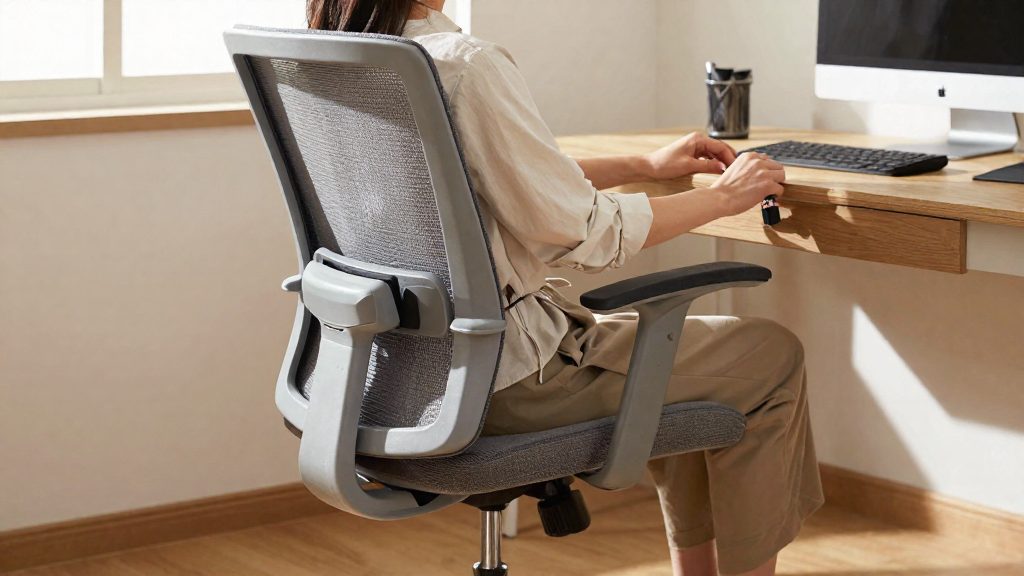
Use a chair with adjustable height and a backrest that supports the lower back. Set the seat height so that your knees form a right angle and your feet rest flat on the floor or on a footrest.
Monitor at or near eye level
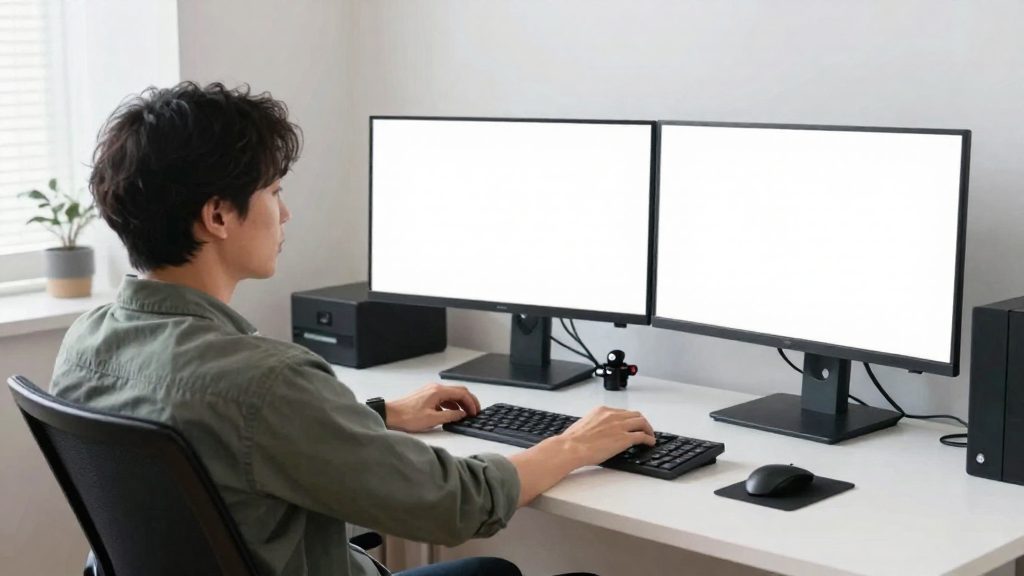
Set the top of the screen at or near eye level so that your head does not tilt downward for long periods. Keep your elbows bent at about 90 degrees while typing, and keep the keyboard within easy reach so your arms do not stretch forward.
| Element | Target position | Source |
|---|---|---|
| Knees | Right angle, feet flat or on a footrest | Hinge Health |
| Elbows | Bent at about 90 degrees | Hinge Health |
| Screen top | At or near eye level | Hinge Health |
Employer ergonomics program
An ergonomics program is a systematic process for identifying and controlling workplace risk factors, and it can include equipment designed to fit the worker. CDC/NIOSH states that employers can reduce musculoskeletal disorders through such a program, and musculoskeletal disorders include disorders of the spinal discs. If your employer provides chairs or monitors, ask whether they can be adjusted to your height and posture.
Stretches and exercises for desk workers
Stretching and light strengthening target the three mechanisms that Hinge Health links to sitting-related lower back pain: tight hip flexors, weaker core and back muscles, and fatigue from static muscle load. The routine below addresses those specific gaps.
Hip flexor stretch for sitting-related shortening
Your hip flexors stay in a shortened position for long periods of sitting. To stretch them:
- Kneel on one knee with the other foot forward, so both hips are at about 90 degrees.
- Keep your torso upright and your ribs stacked over your pelvis.
- Gently shift your hips forward until you feel a pull at the front of the hip on the kneeling side.
- Hold the position while breathing steadily, then repeat on the other side.
Avoid arching your lower back to create more stretch. The pull should come from the hip, not the spine.
Core and back strengthening for daily life
Strengthening the muscles that support the spine addresses the weak core and back muscles that Hinge Health lists as a cause of sitting-related pain. Three simple exercises are useful for desk workers:
- Bridge: Lie on your back with knees bent and feet flat. Lift your hips while keeping your ribs down.
- Bird dog: From hands and knees, extend one arm and the opposite leg in a slow, controlled line.
- Abdominal bracing: Tighten your abdominal wall as if preparing for a light cough, while breathing normally.
Start with a small range of motion and a slow tempo. Increase the difficulty only once the movement feels controlled.
Gentle lumbar mobility at the desk
Short movements during the workday help interrupt static load without leaving your chair:
- Sit tall, then slowly tilt your pelvis forward to lengthen the lower back.
- Return to neutral, then gently round your back and release.
- Rotate your upper body slowly to each side while keeping your hips facing forward.
When is back pain a reason to see a doctor?
Some patterns of lower back pain call for a medical consultation. Some patterns, however, call for a medical consultation. The key distinctions are whether the pain responds to workplace changes, whether symptoms extend into the legs, and whether bladder or bowel function is affected.
Pain that persists or worsens despite workplace changes
If your lower back pain continues or gets worse after you have adjusted your workstation and begun changing position regularly, arrange a medical review. When pain remains after those changes, other contributors may be involved. A doctor can assess these possibilities together.
Numbness, weakness or tingling spreading into the legs
Back pain accompanied by numbness, tingling or weakness that travels into one or both legs is a reason to seek prompt medical advice rather than waiting for the pain to settle. These symptoms can point to a problem affecting the nerves that leave the spine, and they warrant an examination. Note when the symptoms started and whether they are spreading or changing, as this information helps the clinician.
Loss of bladder or bowel control: an emergency signal
Loss of bladder or bowel control combined with back pain is an emergency signal. Do not wait for a scheduled appointment. Call 911 or go to the nearest emergency department straight away. Numbness in the groin or inner thighs alongside these symptoms also needs urgent evaluation.
| Warning pattern | Recommended action |
|---|---|
| Pain that persists or worsens despite workstation changes and regular position breaks | Book a medical consultation |
| Numbness, tingling or weakness spreading into one or both legs | Seek prompt medical advice |
| Loss of bladder or bowel control | Seek emergency care immediately |
Frequently asked questions
Is desk work really a cause of lower back pain, or is the chair to blame?
NIAMS (NIH) lists desk work as a job-related risk factor for back pain, and says the risk increases with poor posture or with sitting all day in an uncomfortable chair. Chair comfort and posture therefore both matter, and neither one alone explains the problem.
How often should you change position to reduce strain?
Hinge Health cites Penn State researchers who found that switching positions every 15 minutes could relieve sitting-related lower back pain. Hinge Health also advises standing and stretching about once an hour. These are guidance figures from secondary sources, not a fixed prescription for every person.
Does a sit-stand desk help with lower back pain?
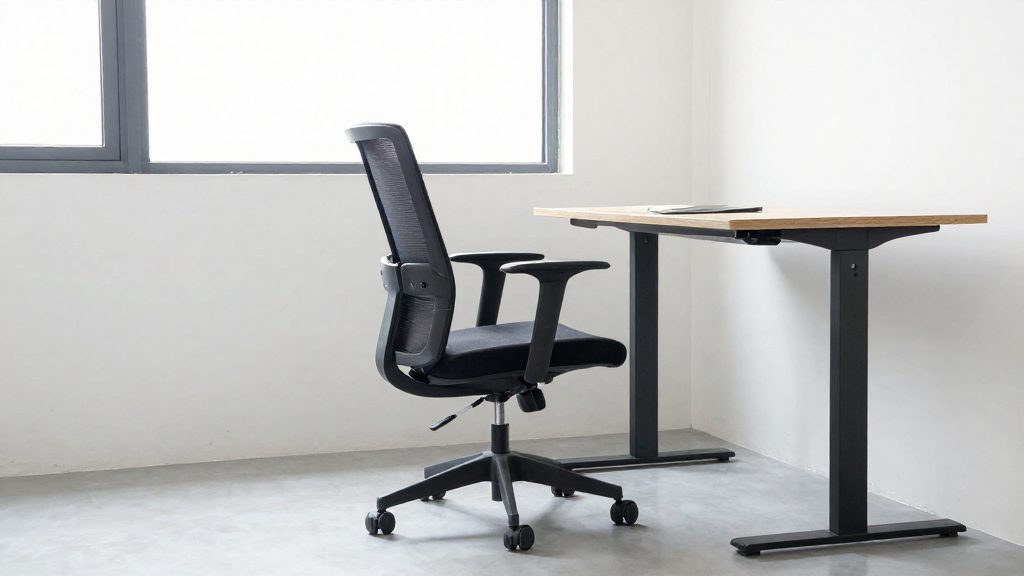
Hinge Health cites a 2018 review in Ergonomics that links sit-stand desks to reduced lower back pain. The review supports the use of these desks as one option for varying posture, but it does not guarantee relief for every user.