Sitting Break Timer for Desk Work
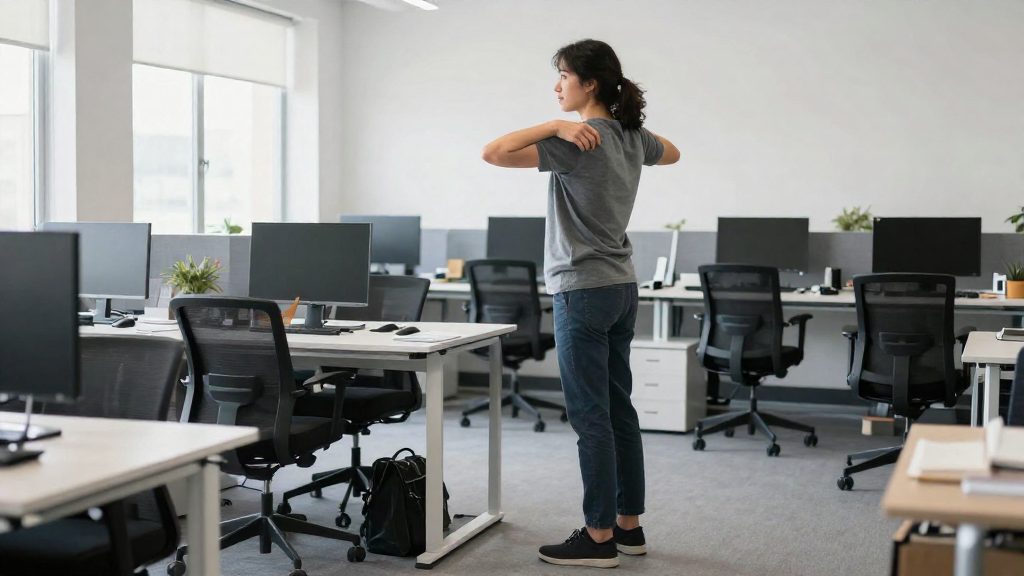
This timer alternates a period of seated work with a short active break, then starts over. The starting durations are meant to be adapted to your day; official bodies mention a break of 5 to 10 minutes per hour, as set out in the method below.
Method and limitations
This timer alternates a period of seated work with an active break. Time is calculated from timestamps rather than by counting down a counter, so it stays accurate when the tab is in the background. The starting values (30 minutes of seated work, 2 minutes of break) are settings you can change, from 15 to 90 minutes for work and from 1 to 15 minutes for the break; they are not an official recommendation. The 30-minute interval is the one used in a randomized trial, not one set by an official body. What the sources say, as our article on sitting breaks reports them: HSE (United Kingdom) advises taking short breaks often rather than longer ones less often, gives an example of 5 to 10 minutes every hour rather than 20 minutes every 2 hours, and states there is no legal guidance on how long or how often. CCOHS (Canada) gives 5 to 10 minutes for every hour at a workstation. The World Health Organization advises limiting sedentary time and replacing it with activity of any intensity, without setting a time limit. In a randomized trial of 49 inactive women office workers, standing or moving for 1 to 2 minutes every half hour cut workday sedentary time by about 36 minutes; a Western University study prompted office workers to take breaks of 2 to 3 minutes every 30 to 45 minutes. Neither study was designed to find an ideal interval, and the results do not necessarily apply to everyone. This is not medical advice: if you have pain or a health condition, ask a health professional. Only your two durations and the sound option are saved, in your browser; the tool works without it.
Sources
- Working safely with display screen equipment: work routine and breaks — Health and Safety Executive (HSE),
- Office Ergonomics - Stretching - At the Workstation — Canadian Centre for Occupational Health and Safety (CCOHS),
- WHO guidelines on physical activity and sedentary behaviour — World Health Organization,
- Comparing the effects of two different break strategies on occupational sedentary behavior in a real world setting: A randomized trial — Preventive Medicine Reports (Kansas State University), via PMC,
- Study finds prescribed work breaks can counter effects of sitting — Western University (Western News),