Desk Height Calculator by Body Height
Your body height gives a first reference for setting the chair and the desk. The calculation rests on measurements of more than 6,000 adults and shows each height with a range, because two people of the same height do not share the same proportions.
Method and limitations
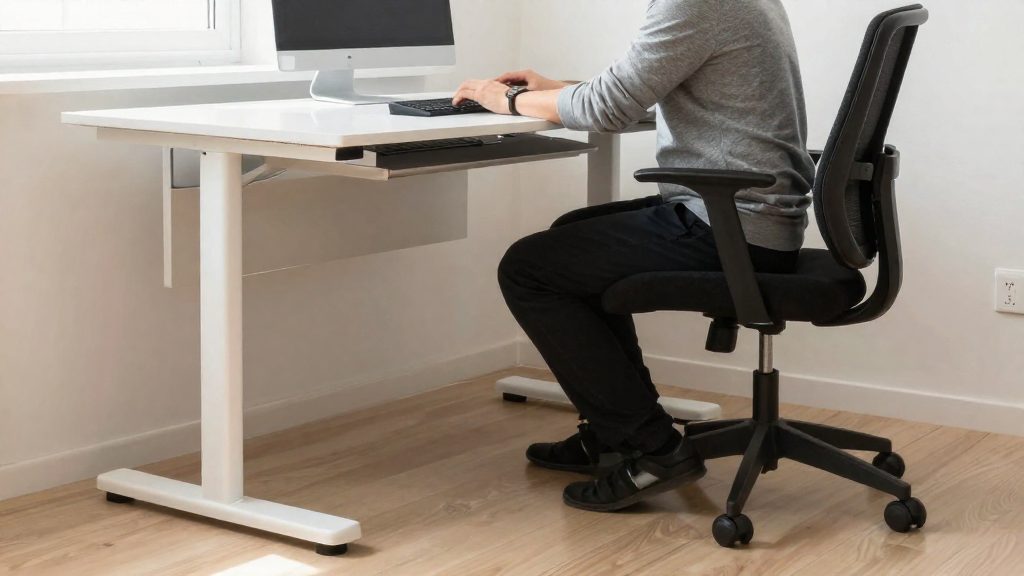
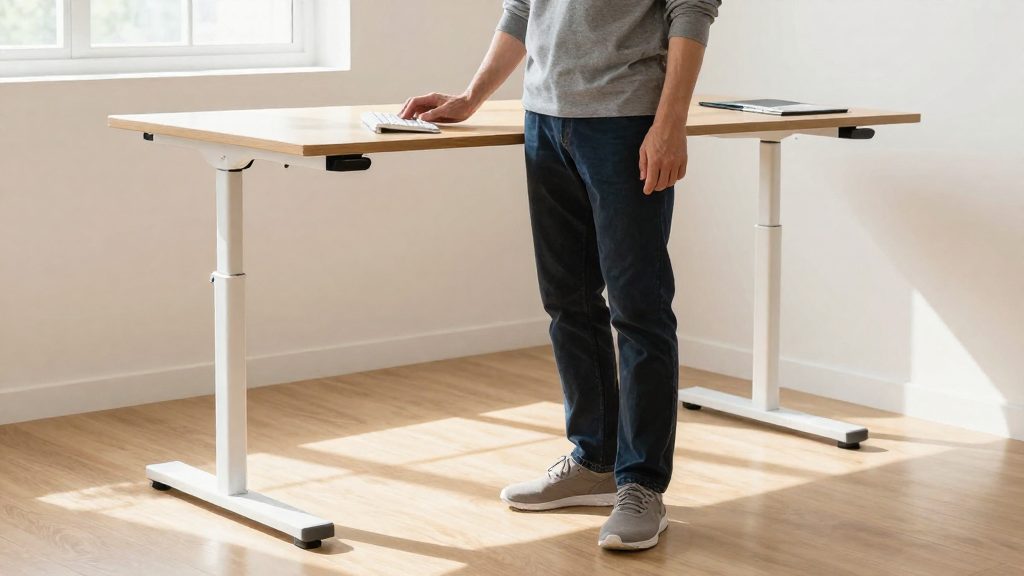
The figures come from a linear regression calculated on 2026-11-11 from the public ANSUR II files (US Army, 2012): 6,068 adults measured barefoot, men and women pooled. Seat height (popliteal height) = −12.03 + 0.313 × body height, in cm (R² 0.81, residual standard deviation 1.36 cm). Seated desk height (seated elbow height above the floor: popliteal height plus elbow rest height) = −1.70 + 0.393 × body height (R² 0.69, standard deviation 2.35 cm). Standing desk height (standing elbow height) = −4.16 + 0.638 × body height (R² 0.92, standard deviation 1.67 cm); ANSUR does not measure this directly, so it is estimated as acromion height minus shoulder-elbow length. The sole thickness you enter is added as is to all three values; ANSUR is measured barefoot and no shoe correction is sourced, so the default is 0. The range shown is the central value plus or minus one residual standard deviation: an individual can fall outside it. Limitations: adult US military population, sample measured between 141 and 199 cm (beyond that the line is extended), no allowance for body proportions, not medical advice. Treat the result as a starting point, then adjust by feel: elbows close to the body, shoulders relaxed, forearms roughly horizontal. Inches: 1 in = 2.54 cm exactly, rounded to one decimal.
Sources
- ANSUR II public data — The OPEN Design Lab, Penn State,
- ANSUR_II_MALE_Public.csv — The OPEN Design Lab, Penn State,
- ANSUR_II_FEMALE_Public.csv — The OPEN Design Lab, Penn State,